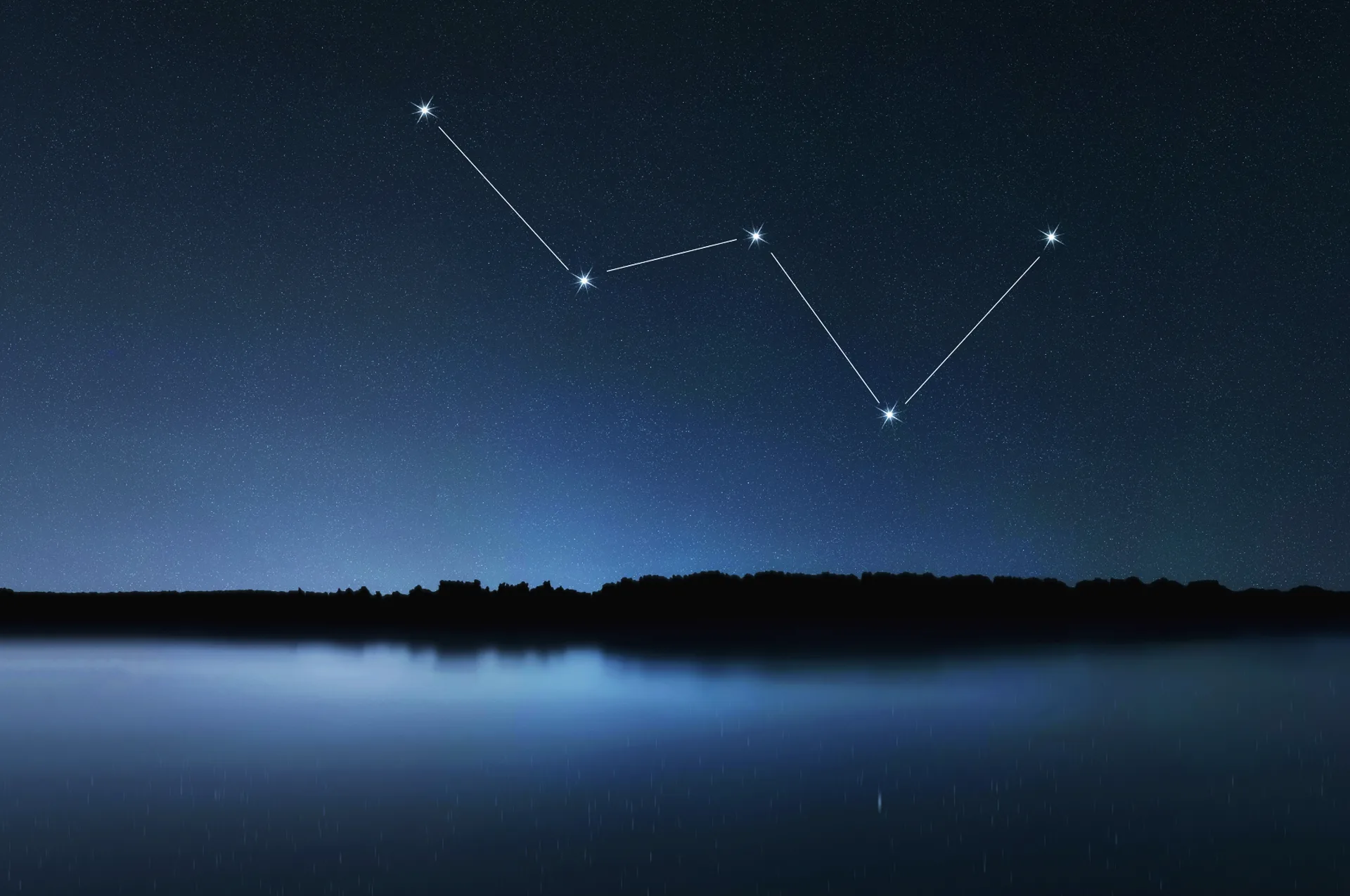
How to Find Cassiopeia is easier than you might think. Look toward the northern sky and you may spot five bright stars forming a distinctive shape that looks like a W or M. This familiar pattern belongs to Cassiopeia, one of the easiest constellations for beginners to recognize.
But Cassiopeia is more than just a recognizable pattern of stars. It sits along the rich Milky Way and is surrounded by star clusters, nebulae, and other fascinating deep-sky objects. From many northern locations, it is also circumpolar, meaning it can remain above the horizon throughout the night.
If you’re new to stargazing, learning how to find Cassiopeia can give you an excellent starting point for exploring the northern night sky. With just your eyes and a reasonably dark location, you can find this famous constellation without a telescope.
How to Find Cassiopeia Using Polaris
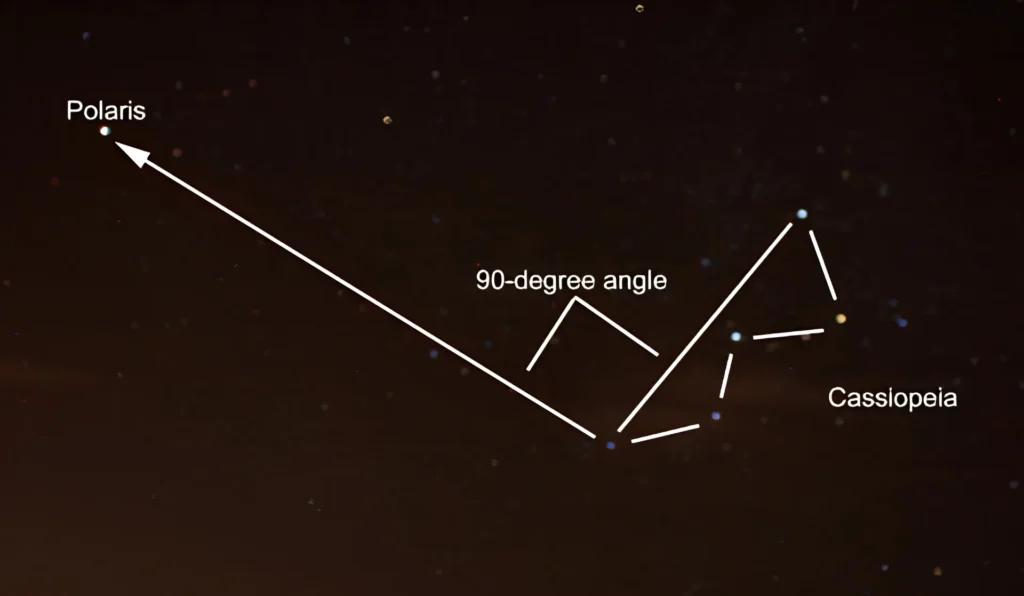
Annotated night-sky view showing Cassiopeia’s distinctive five-star pattern and the direction toward Polaris, the North Star.
The easiest way to begin is to face north and locate Polaris, the North Star. Cassiopeia and the Big Dipper appear on opposite sides of the North Celestial Pole, so these familiar patterns can help you orient yourself.
Once you find the northern part of the sky, scan for five fairly bright stars forming a wide, uneven zigzag.
You may not always see a perfect W. Cassiopeia appears to rotate around the North Celestial Pole, so its shape can resemble an M, W or tilted zigzag depending on the time of night and season.
The important thing is to recognize the five-star pattern rather than expecting one fixed orientation.
If you are still learning your way around the night sky, our How to Stargaze Without a Telescope: A Beginner’s Guide explains several simple techniques for naked-eye observing.
How to Find Cassiopeia in Different Seasons
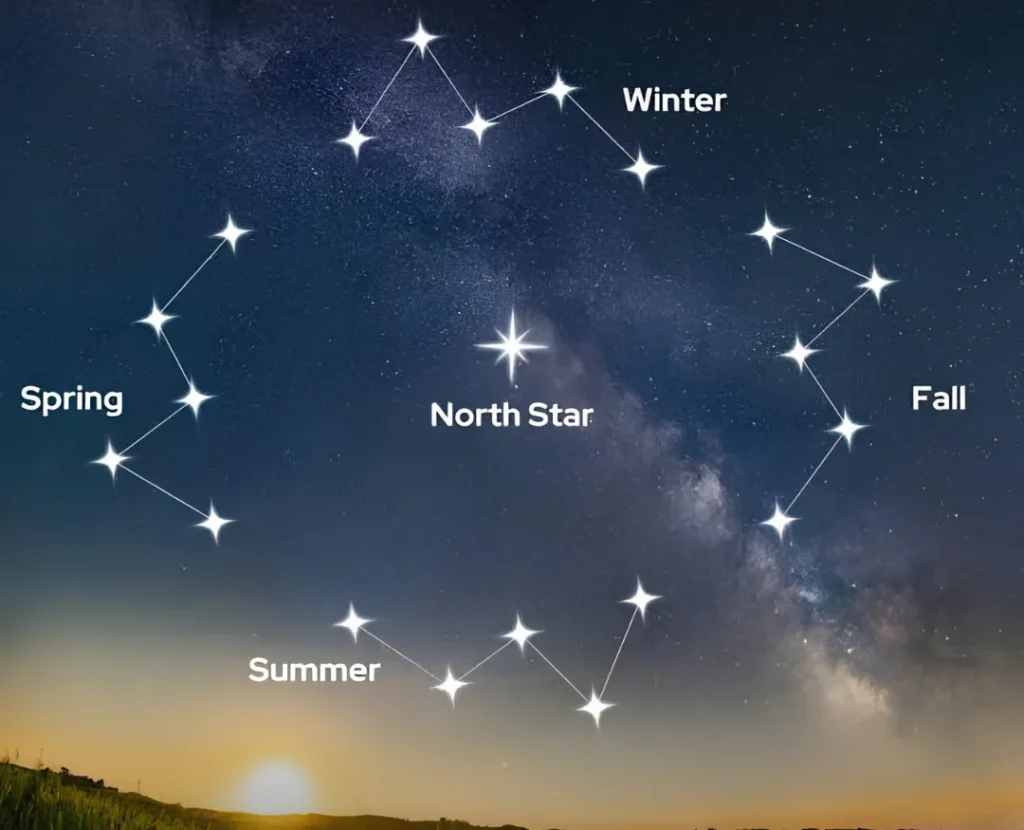
Illustration showing how the Cassiopeia constellation appears to rotate around Polaris throughout spring, summer, fall and winter.
Although Cassiopeia can remain visible throughout the year from many northern locations, its position changes as Earth rotates and orbits the Sun.
During autumn and winter evenings, the constellation is particularly noticeable high in the northern sky. NASA describes its distinctive W-shaped pattern as especially prominent during these seasons.
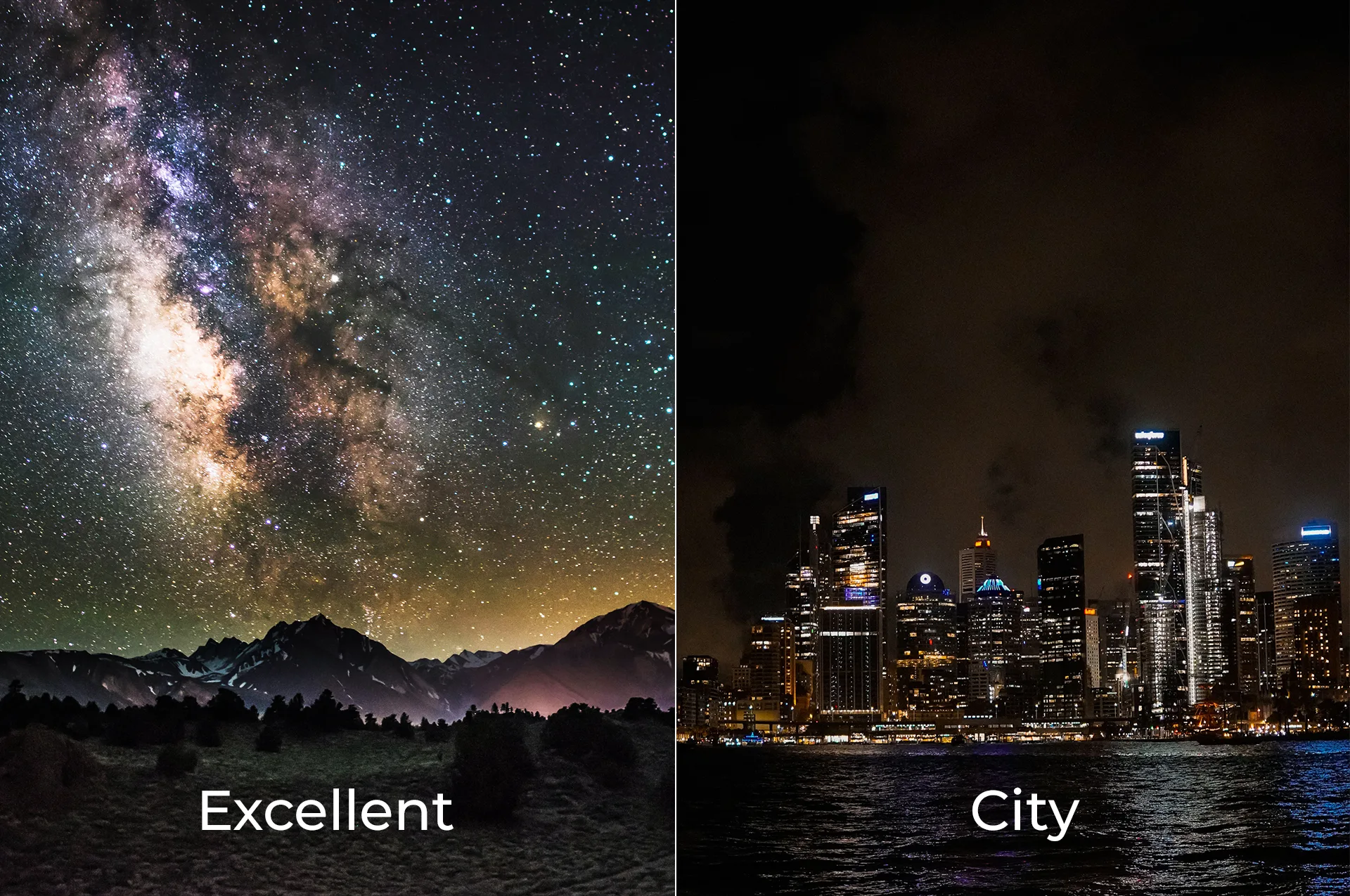
If you are struggling to see it, move away from bright streetlights and give your eyes several minutes to adjust to the darkness. You do not need a telescope to identify Cassiopeia.
Once you recognize the W-shaped pattern, you can use it as a guide to explore nearby parts of the sky, including Perseus and the Andromeda region.
For better observing conditions, our guide to the best time to stargaze explains how darkness, weather and Moon phase affect what you can see.
What Can You See Near Cassiopeia?
Finding Cassiopeia is only the beginning.
The constellation lies within a particularly rich part of the Milky Way, where binoculars can reveal dense fields of stars, open clusters and faint nebulae.
One famous nearby target is the Double Cluster in Perseus. Cassiopeia itself also contains several notable open clusters, including M52, M103 and NGC 7789.
One of Cassiopeia’s prominent stars is Schedar, an orange giant that forms part of the constellation’s familiar zigzag.
Another important star is Gamma Cassiopeiae, located near the center of the W. Near it lies IC 63, often called the Ghost Nebula. NASA notes that Gamma Cassiopeiae is visible to the unaided eye, while IC 63 requires a telescope to observe.
NASA: The Ghost Nebula in Cassiopeia
The region also contains unusual stars such as Rho Cassiopeiae, a distant yellow hypergiant.
So once you learn how to find Cassiopeia, that simple W in the northern sky becomes much more than a constellation. It can serve as a gateway to star clusters, nebulae and a much larger section of the Milky Way.
Look Up. Observe Vastness.
LUOV