

How telescopes see into the past is one of the most fascinating ideas in astronomy. It may sound like science fiction, but telescopes do not actually travel backward through time.
Instead, they collect light that has been traveling across space for seconds, years, millions of years, or even billions of years before finally reaching us.
Because light takes time to travel, looking farther into space also means looking farther back in time. This allows astronomers to observe ancient stars, distant galaxies, and some of the earliest structures that formed in the universe. NASA describes looking into deep space as essentially looking back through cosmic history.
How Telescopes See Into the Past Through Light
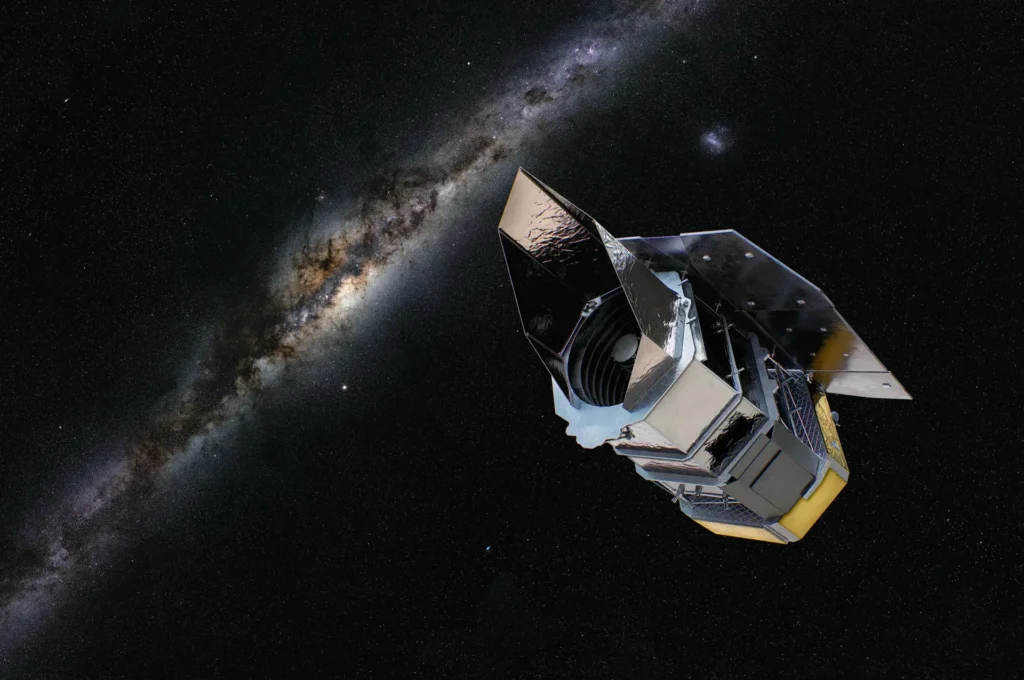
Artist’s illustration of NASA’s Nancy Grace Roman Space Telescope observing the Milky Way. Credit: Roen Kelly, after NASA. Background image: ESO/S. Brunier
The secret behind how telescopes see into the past is the speed of light.
Light travels incredibly fast — approximately 300,000 kilometers (186,000 miles) per second — but the universe is unimaginably large. Even at this enormous speed, light needs time to travel between objects in space.
The light reflected from the Moon takes about 1.3 seconds to reach Earth. Sunlight takes roughly 8 minutes and 20 seconds to reach us. This means we never see these objects exactly as they are at this instant. We see them as they appeared when the light began its journey toward us.
The same principle applies to stars. If a star is 100 light-years away, the light reaching your telescope left that star about 100 years ago.
A light-year is actually a measurement of distance — the distance light travels in one year — but it naturally connects enormous cosmic distances with enormous spans of time.
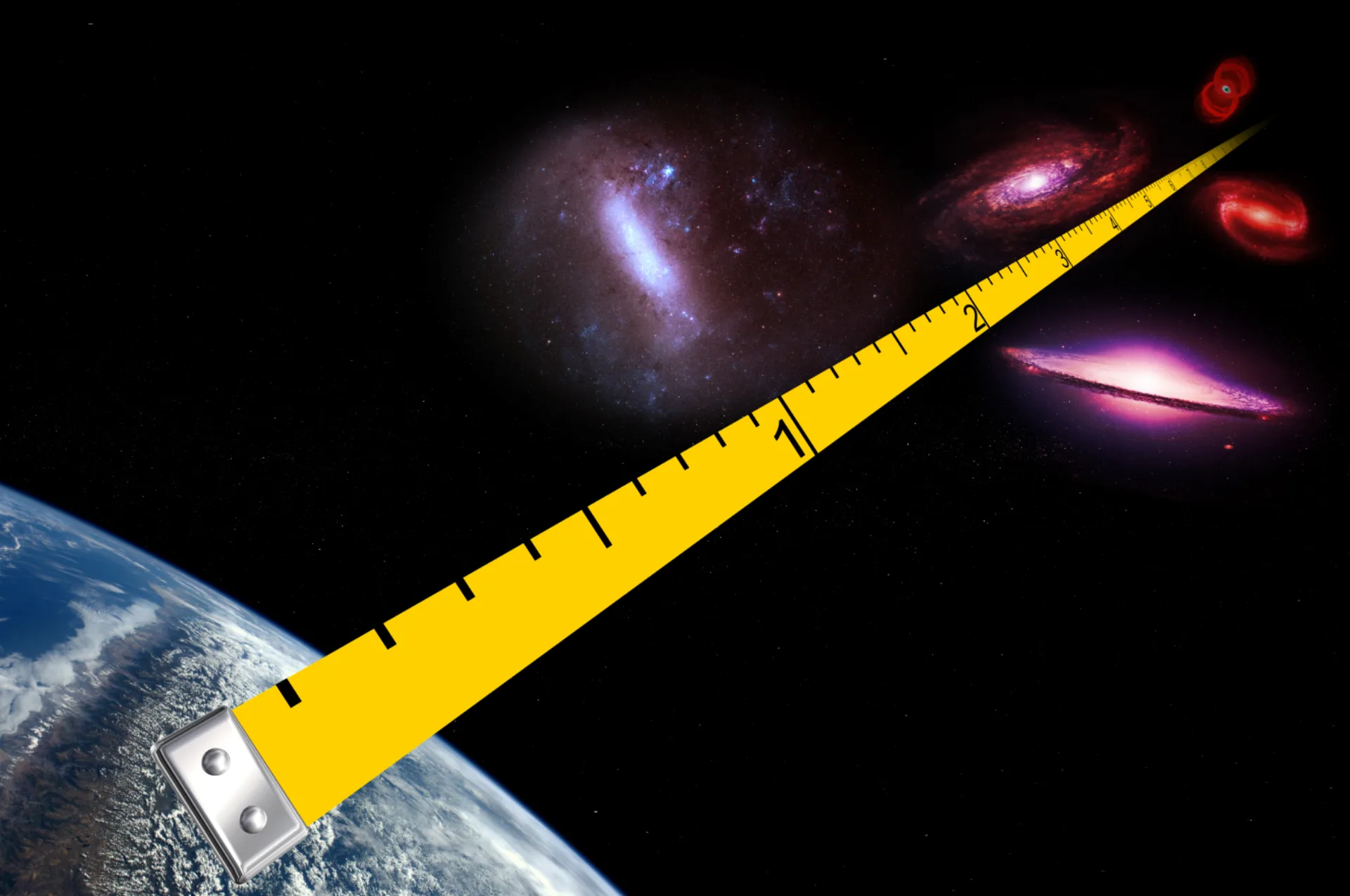
The Farther We Look, the Further Back in Time We See
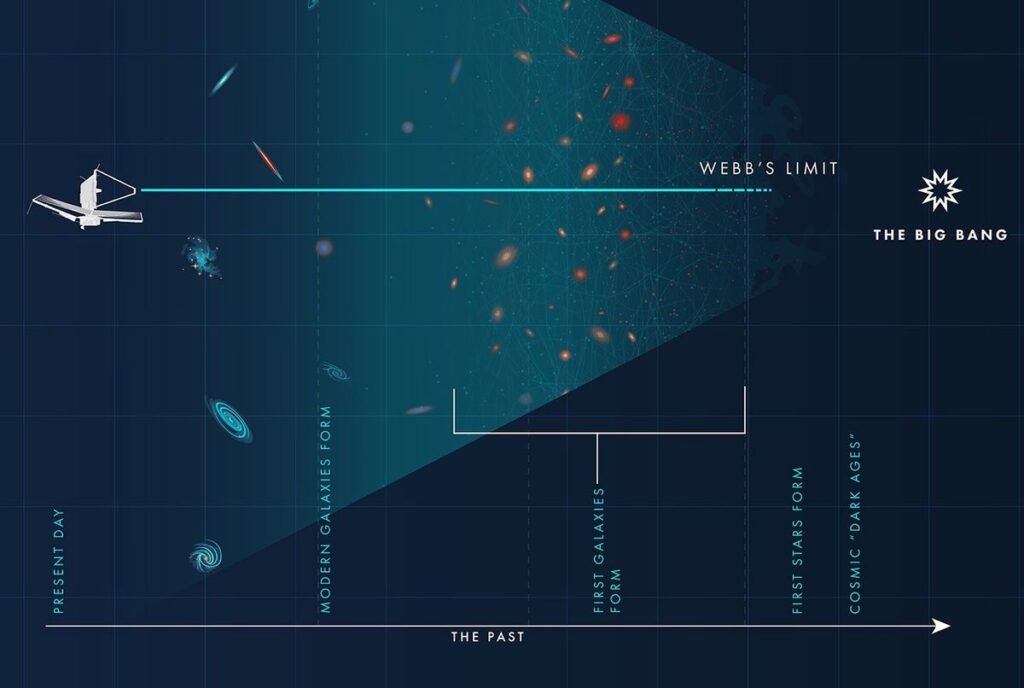
Illustration showing how Webb observes increasingly distant galaxies and looks back toward the early universe. Credit: NASA
When astronomers observe increasingly distant galaxies, they are also observing increasingly earlier periods of cosmic history.
Light from some of the most distant galaxies detected by the James Webb Space Telescope began its journey more than 13 billion years ago. We therefore see those galaxies not as they are today, but as they existed when the universe was only a few hundred million years old.
Some of those galaxies may have completely transformed since that ancient light left them. They may have produced billions of new stars, merged with other galaxies, or evolved into much larger systems.
This is why astronomers sometimes describe telescopes as time machines. They do not manipulate time; they simply capture increasingly ancient light.
If you want to compare how different observatories accomplish this, explore our guide to Roman vs James Webb vs Hubble.
How Powerful Telescopes Detect Ancient Light
The farther away an object is, the fainter it generally appears, which is why powerful telescopes are essential for studying the distant universe.
Large telescope mirrors can collect greater amounts of light. Extremely sensitive instruments can then detect faint signals that would otherwise remain invisible.
But there is another challenge.
As the universe expands, the space through which light travels also expands. This stretches the wavelengths of light toward longer wavelengths, an effect known as cosmological redshift. Light originally emitted at ultraviolet or visible wavelengths by very distant galaxies can therefore reach us as infrared light.
This is one of the main reasons the James Webb Space Telescope was designed primarily as an infrared observatory. Webb can detect highly redshifted light from galaxies that existed extraordinarily early in cosmic history.
Explore NASA’s explanation of cosmological redshift
How Far Back Can Telescopes See?
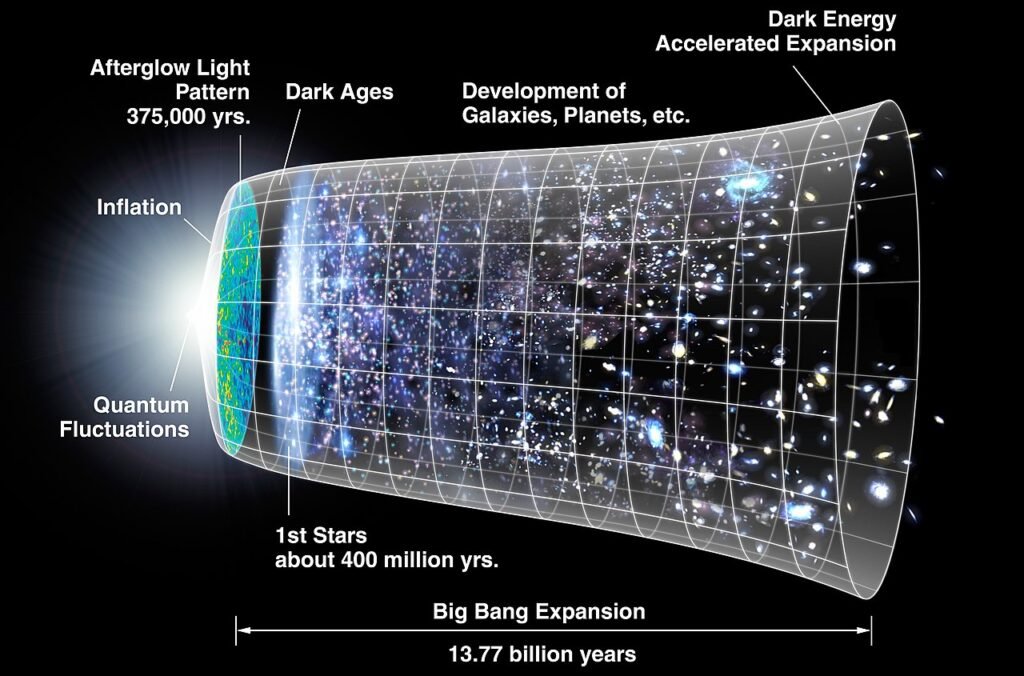
Illustration showing the evolution of the universe from the Big Bang and cosmic dark ages to the formation of galaxies and today’s accelerated expansion. Credit: NASA
Telescopes cannot simply point toward the Big Bang and photograph the moment the universe began.
During its earliest period, the universe was extremely hot and dense. Free electrons repeatedly scattered light, making the cosmos effectively opaque.
Around 380,000 years after the Big Bang, the universe cooled enough for electrons and atomic nuclei to combine into atoms. Light could finally travel freely through space. That ancient glow still surrounds us today as the cosmic microwave background, or CMB — the oldest light we can directly observe.
Astronomers can therefore study different chapters of cosmic history using different types of observations. The cosmic microwave background reveals the infant universe, while telescopes such as Webb observe early galaxies that appeared hundreds of millions of years later.
Our universe is about 13.8 billion years old, and understanding how scientists determine that age requires several different measurements. You can explore those methods in our article explaining how scientists know the age of the universe.
James Webb and the Early Universe
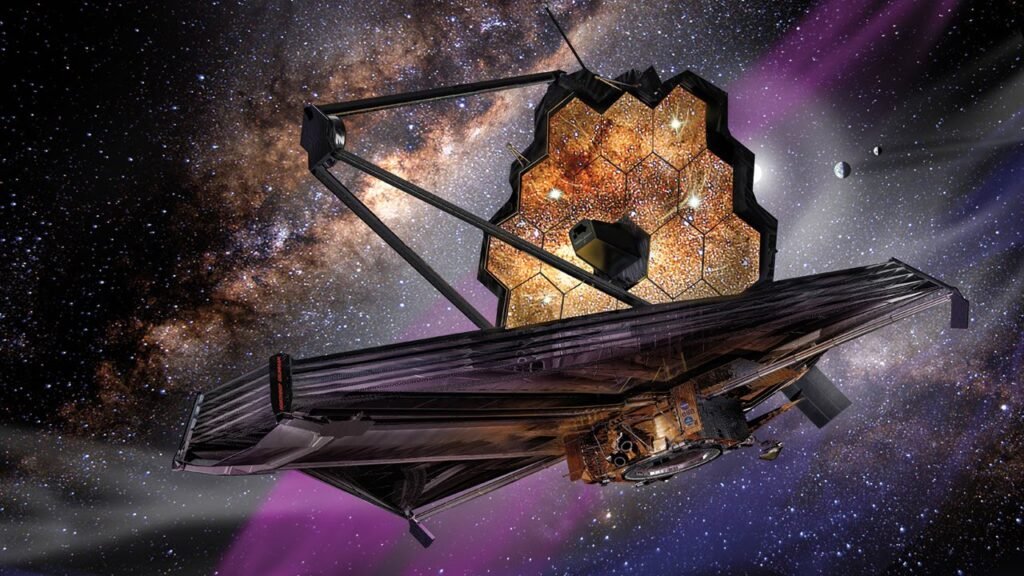
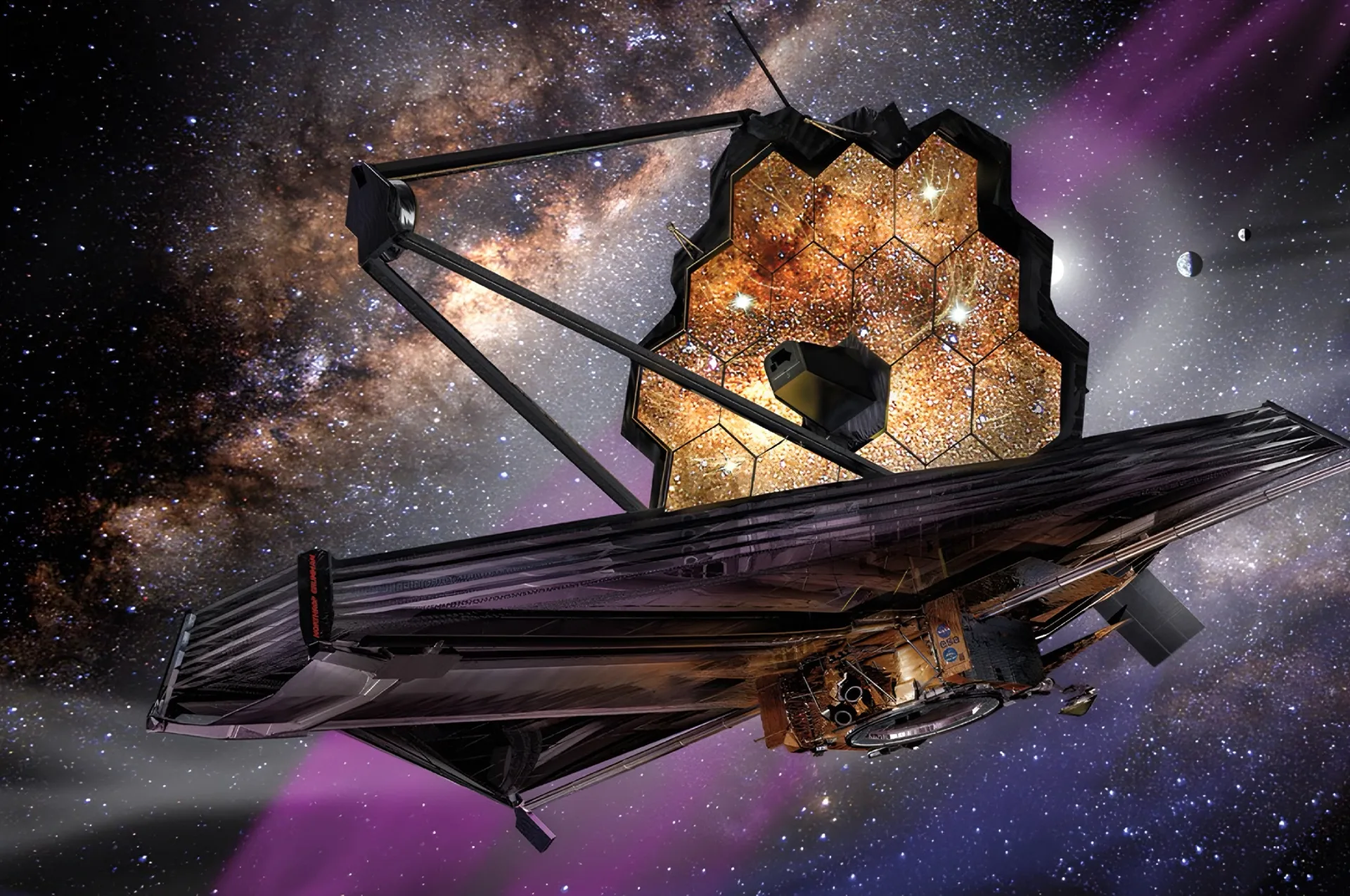
Artist’s illustration of the James Webb Space Telescope observing deep space with its infrared instruments.
The James Webb Space Telescope has pushed observations particularly far into the cosmic past.
Its infrared instruments are designed to detect the stretched light of extremely distant galaxies. NASA says Webb has observed galaxies whose light left them more than 13 billion years ago, allowing scientists to study the universe only a few hundred million years after the Big Bang.
These early galaxies do not always resemble the large, familiar spiral galaxies around us today. Observations suggest that many young galaxies had unusual shapes and were undergoing intense periods of star formation.
By comparing very distant galaxies with closer ones, astronomers can begin reconstructing how galaxies grew and changed over billions of years.
Telescopes Are Looking at Cosmic History
Every astronomical observation carries information through light.
When we look at the Moon, we see it about 1.3 seconds in the past. The Sun appears roughly 8 minutes ago, while extremely distant galaxies can show us the universe as it was more than 13 billion years ago.
This is what makes how telescopes see into the past so remarkable. They do not bend time — they simply collect ancient light that has traveled across space for enormous periods.
By looking deeper into space, astronomers can explore earlier chapters of cosmic history. New observatories such as NASA’s Roman Space Telescope will expand that view even further.
Look Up. Observe Vastness.
LUOV
One comment
Could looking into the past explain why we haven’t detected extraterrestrial life?
We know that when we observe a distant planet or star, we are seeing it as it was when the light left it, not as it exists today.
For example, if we observe a planet 10 billion light-years away, the light reaching us today began its journey roughly 10 billion years ago. Suppose there was no life on that planet when the light was emitted, but life evolved there billions of years later.
Wouldn’t this mean that we could observe that planet and conclude that it has no detectable life, even though life might exist there today?
Could this “looking into the past” effect be one of the reasons we haven’t detected extraterrestrial life yet?
More generally, how much does the light-travel-time problem limit our ability to determine whether life currently exists on distant planets?