Real space photos can sometimes look so strange that they are difficult to believe. From geometric storms on distant planets to nebulae shaped like animals and glowing rings created by gravity, genuine astronomical images can look more like science fiction than reality.
These space photos that look fake are not computer-generated scenes. They come from spacecraft, satellites, and telescopes observing real objects and events across the Solar System and beyond. Here are seven unbelievable examples, along with the science behind what you are actually seeing.
1. Saturn’s Hexagon
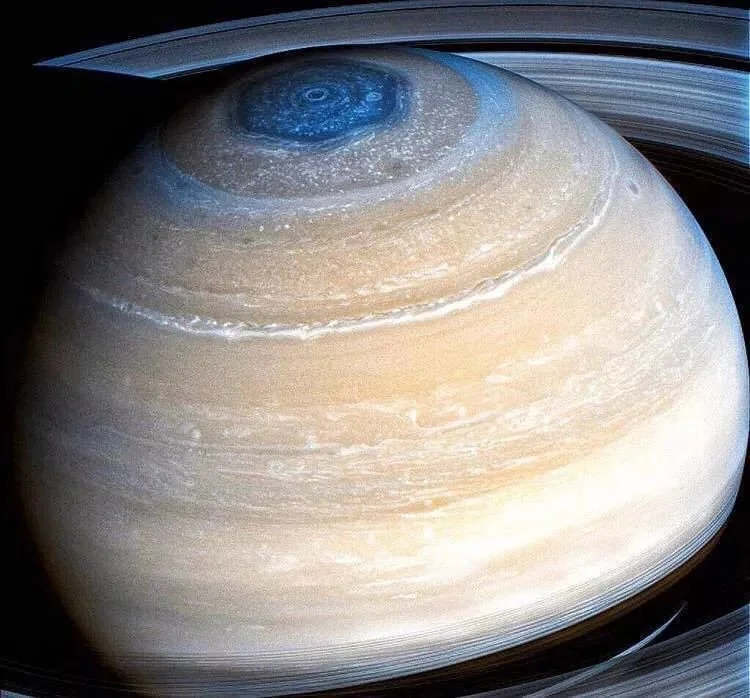
Saturn’s hexagon photographed by NASA Cassini spacecraft, Credit: NASA
Saturn’s north pole is home to one of the strangest weather patterns ever observed on another world. A huge six-sided cloud pattern surrounds the planet’s northern polar region, creating something that looks almost like computer-generated artwork.
The structure is actually a giant jet stream surrounding Saturn’s north pole. Unlike many weather patterns that change quickly, the hexagon has remained remarkably persistent for decades. It was observed by the Voyager spacecraft in the early 1980s and later photographed in extraordinary detail by NASA’s Cassini spacecraft.
NASA describes the feature as a stationary atmospheric wave, with powerful winds flowing around the pole.
Explore Saturn’s strange hexagon with NASA
What you’re actually seeing: A real six-sided atmospheric pattern created by powerful winds on Saturn.
2. Earth and the Moon From Deep Space
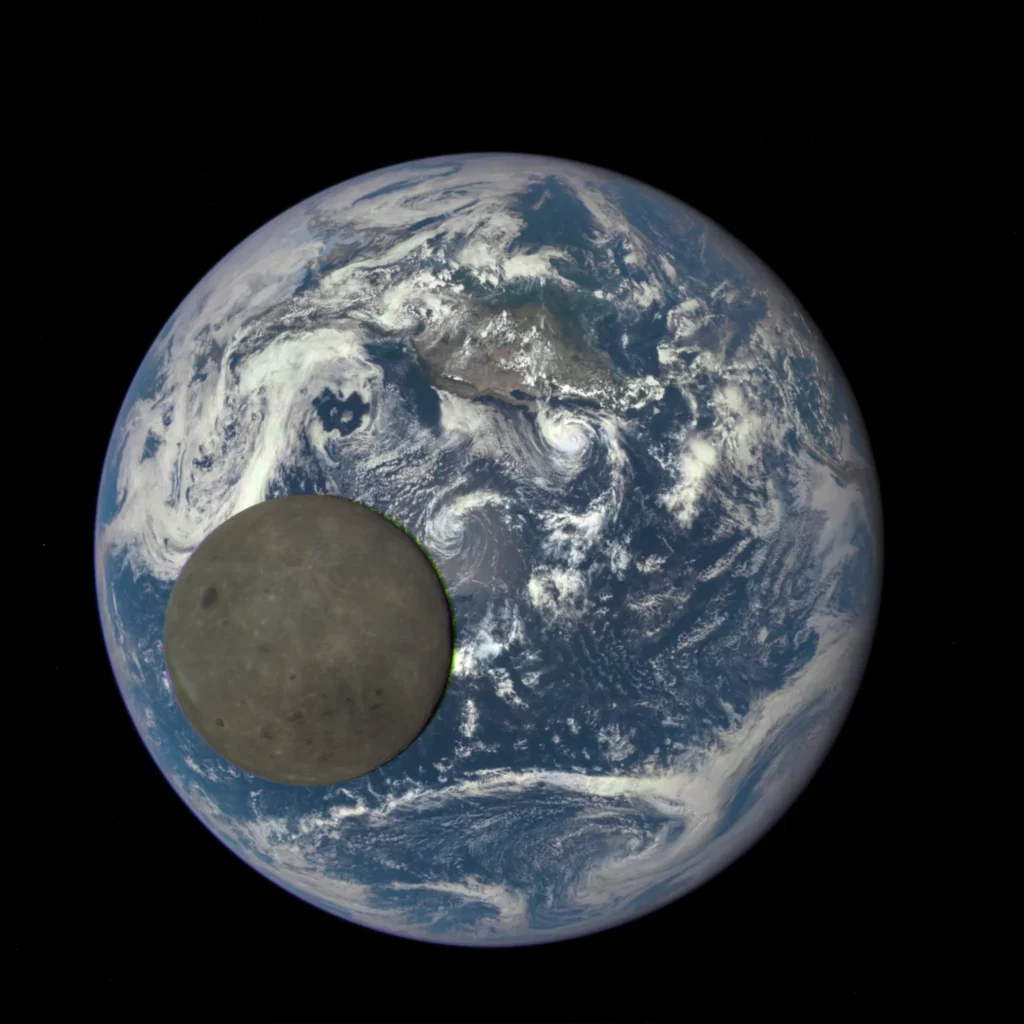
Earth and the Moon photographed together from deep space by NASA’s DSCOVR spacecraft in 2015., Credit: NASA
Seeing Earth and the Moon together from far away can make our home planet look strangely small. The two worlds appear almost like objects placed against a completely black background, which can make the photograph look like a carefully constructed digital image.
But the scene is real. Spacecraft have photographed Earth and the Moon from enormous distances, allowing us to see their relative positions from perspectives that are impossible from the ground. Without an atmosphere surrounding the camera, there is also no familiar blue sky or hazy horizon to make the scene look more like an Earth photograph.
What you’re actually seeing: Earth and the Moon photographed together from deep space by NASA’s DSCOVR spacecraft in 2015.
3. The Horsehead Nebula
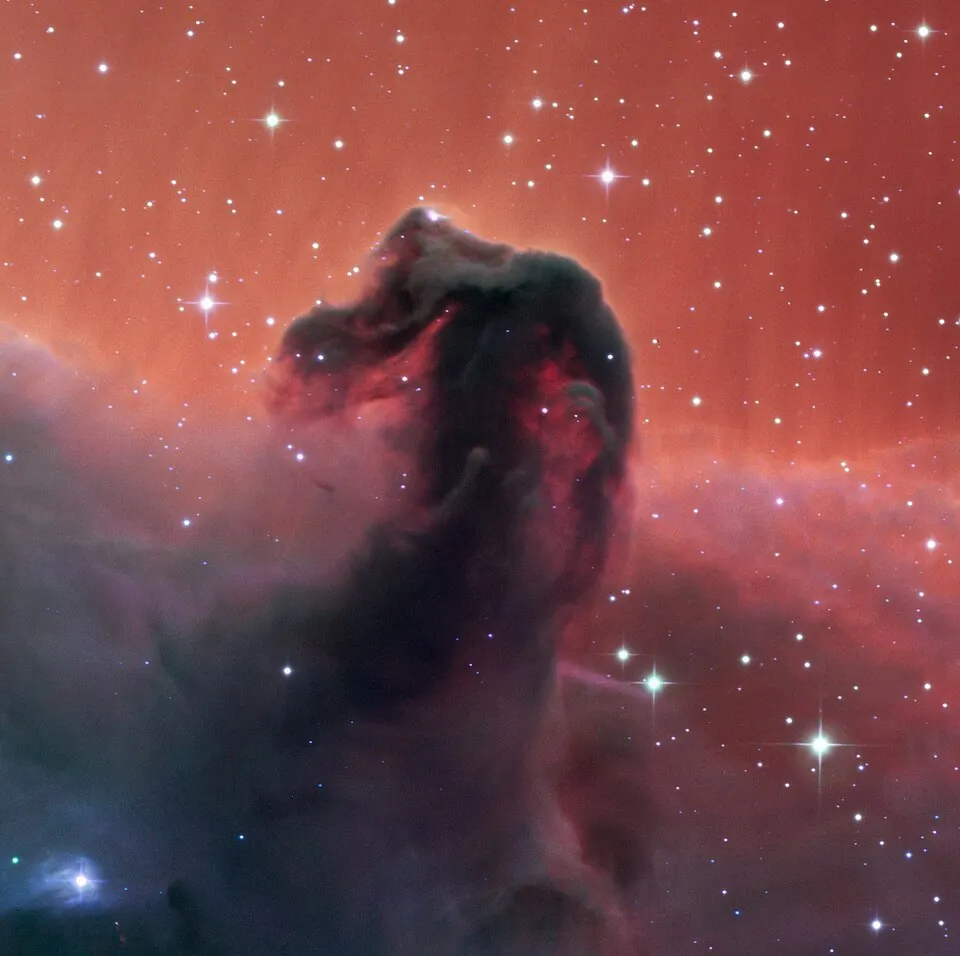
The Horsehead Nebula, a dark cloud of dust about 1,300 light-years away, photographed with ESO’s 8.2-m Very Large Telescope in Chile. Credit: ESO / Very Large Telescope (VLT)
The Horsehead Nebula looks so much like the head of a horse that it almost seems too perfectly shaped to be natural.
Also known as Barnard 33, it is actually a cold, dark cloud of gas and dust silhouetted against the bright nebula IC 434. Dense material blocks much of the light coming from behind it, producing the famous dark silhouette. Radiation from nearby stars is also slowly sculpting and eroding the cloud.
The resemblance to a horse is simply an extraordinary coincidence created by enormous clouds of material in space.
Explore the Horsehead Nebula with NASA
What you’re actually seeing: A dark cloud of gas and dust silhouetted against glowing material behind it.
4. The Butterfly Nebula
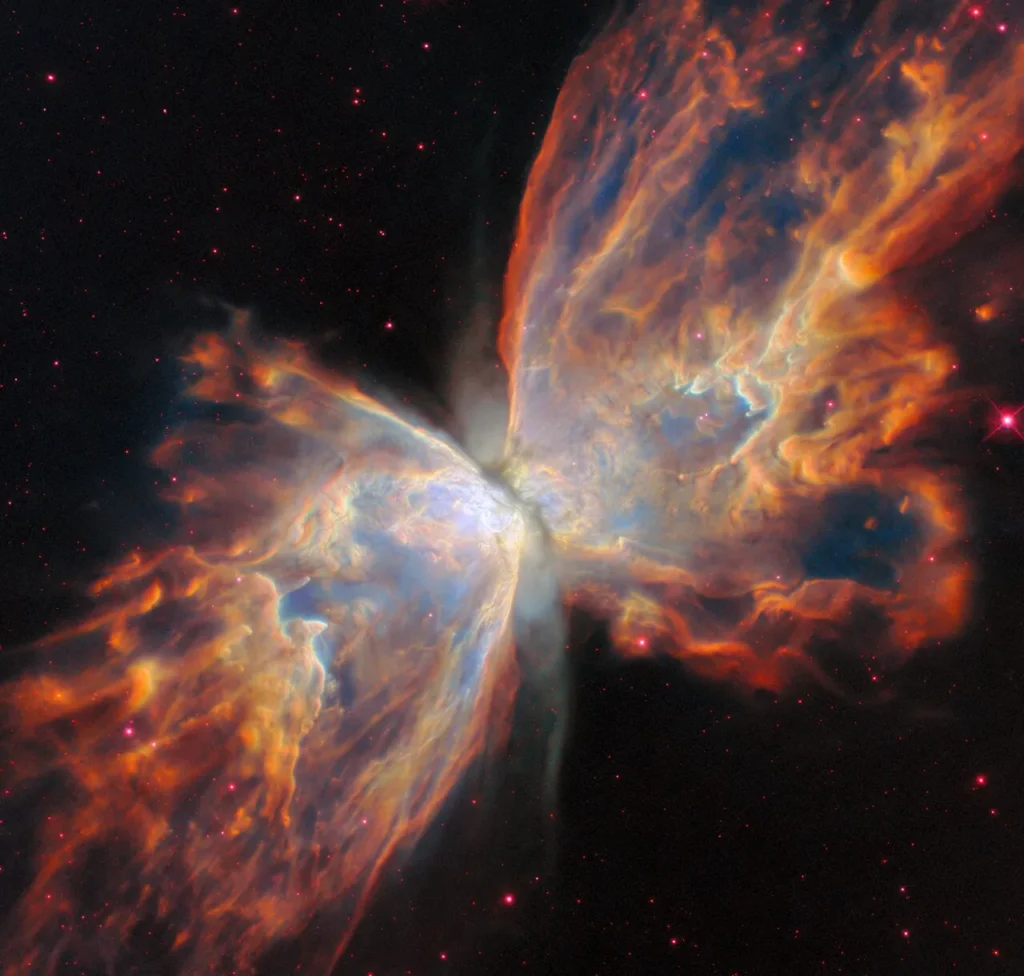
The Butterfly Nebula (NGC 6302), a dying star surrounded by vast glowing clouds of gas, photographed by the NASA/ESA Hubble Space Telescope. Credit: ESA/Webb, NASA & CSA
This object looks like a giant butterfly with two enormous wings stretching through space. It is actually NGC 6302, commonly known as the Butterfly Nebula.
The structure is a planetary nebula produced during the final stages of stellar evolution. The star at its center expelled layers of material into surrounding space, creating the vast glowing wings visible today.
Those delicate-looking wings are anything but peaceful. NASA observations show gas within them traveling at more than 600,000 miles per hour, while parts of the material are heated to more than 36,000°F (about 20,000°C).
See NASA’s Butterfly Nebula image
What you’re actually seeing: Glowing material expelled during the final stages of a star’s life.
5. The “Eye of God” (Helix Nebula)
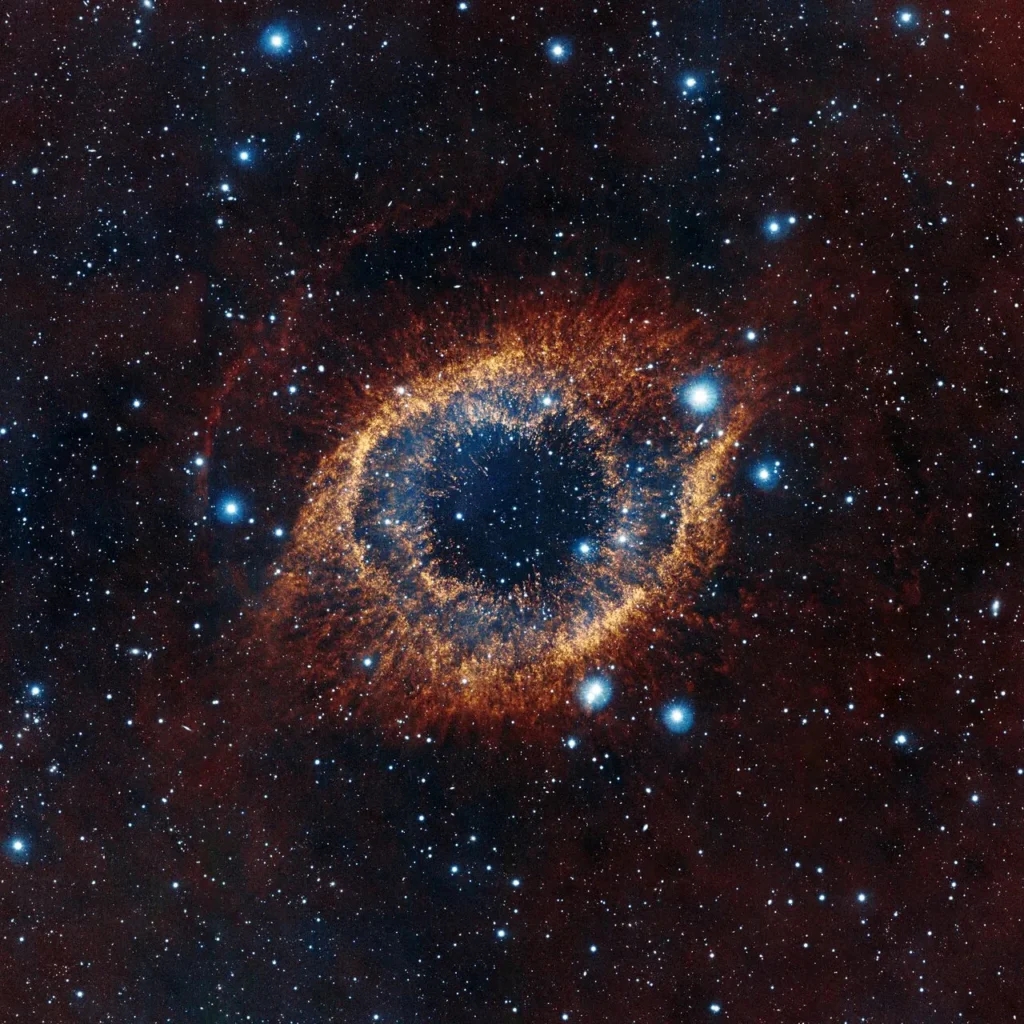
The Helix Nebula (NGC 7293), glowing gas shed by a dying Sun-like star about 700 light-years away, photographed in infrared light by ESO’s VISTA telescope in Chile. Credit: ESO/VISTA/J
The Helix Nebula is sometimes nicknamed the “Eye of God” because of its striking appearance. Its central region surrounded by enormous layers of glowing material can resemble a giant eye floating through space.
The resemblance is purely visual.
The Helix, officially known as NGC 7293, is a planetary nebula created as a Sun-like star reached the end of its life and expelled its outer layers into space. The remaining stellar core illuminates the material surrounding it.
NASA’s James Webb Space Telescope has also observed the Helix in infrared light, revealing intricate structures that are difficult to see at other wavelengths.
Explore the Helix Nebula with NASA Webb
What you’re actually seeing: Expanding material surrounding the remains of a dying star.
6. The Pillars of Creation
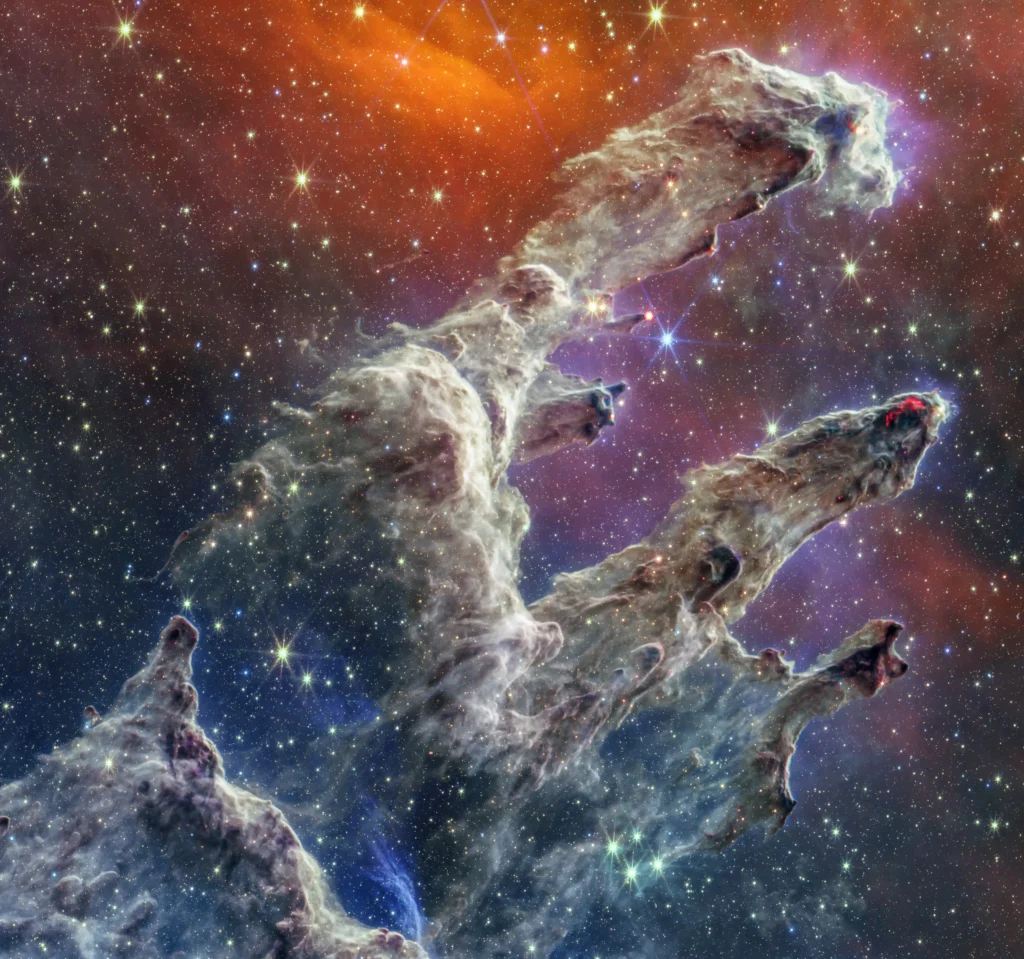
The Pillars of Creation, vast star-forming clouds of gas and dust 6,500 light-years away, photographed in infrared light by the James Webb Space Telescope. Credit: NASA
Few real space photos are as famous as the Pillars of Creation.
These enormous structures resemble rocky mountains floating through a colorful cosmic landscape, but they are actually vast clouds of gas and dust inside the Eagle Nebula.
Powerful radiation and stellar winds from young stars are sculpting the pillars, while dense regions of gas and dust are associated with ongoing star formation. The structures themselves stretch across several light-years.
Both Hubble and the James Webb Space Telescope have photographed the Pillars of Creation. Hubble’s visible-light observations emphasize the opaque clouds, while Webb’s infrared vision can peer through more of the dust and reveal many young stars.
Compare NASA’s Hubble and Webb images of the Pillars of Creation
What you’re actually seeing: Giant clouds of gas and dust inside a stellar nursery.
7. Einstein Ring
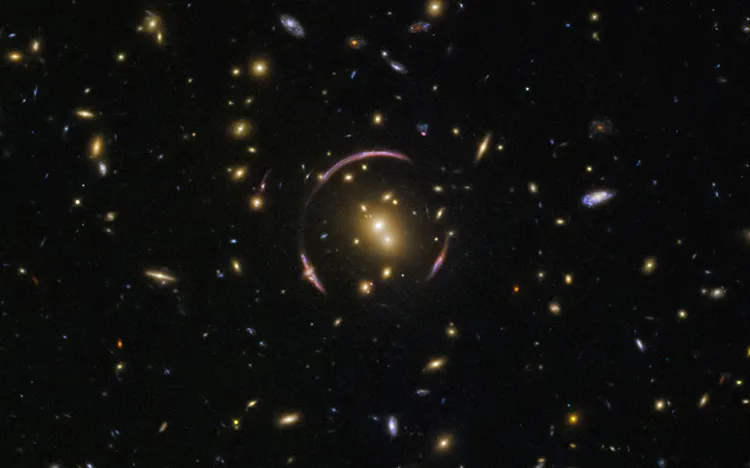
A partial Einstein ring, created as a foreground galaxy bends and magnifies the light of a much more distant galaxy, photographed by the Hubble Space Telescope. Credit: ESA/Hubble & NASA
A galaxy appearing as a glowing ring around another object looks almost impossible. It can seem as though someone digitally stretched a distant galaxy into a perfect circle, but the effect is created by gravity.
When light from a distant galaxy passes near a massive foreground galaxy or galaxy cluster, gravity bends and distorts the path of that light. This phenomenon is known as gravitational lensing.
When the distant object, foreground lens, and observer are aligned particularly well, the distorted light can form a complete or partial Einstein ring. These rings were predicted by Einstein’s theory of gravity and have since been observed by telescopes including Hubble. Gravitational lensing can also magnify distant galaxies, helping astronomers study objects that would otherwise be extremely difficult to observe.
Learn about gravitational lensing and Einstein rings with NASA
If phenomena like Einstein rings fascinate you, explore more of The most mysterious objects ever found in space.
What you’re actually seeing: Light from a distant object being bent and magnified by gravity.
Why Do Real Space Photos Sometimes Look Fake?
These space photos that look fake are a reminder that reality does not always look the way we expect. Saturn can produce a giant hexagon, dying stars can create butterfly-shaped clouds, and gravity can distort the appearance of an entire galaxy.
It is also important to understand how astronomical images are created. Space telescopes often observe wavelengths of light that human eyes cannot see. Scientists can combine observations taken through different filters and assign visible colors to individual wavelengths so that structures hidden in the data become easier to study.
NASA explains, for example, that Hubble and Webb images of the Pillars of Creation are composites created from separate observations through multiple filters, with different colors assigned to those measurements.
That processing does not mean the objects are fake. The underlying light and structures come from real astronomical observations collected by scientific instruments.
If you enjoy the more artistic side of the universe, you can also explore our collection of 10 Space photos that look like paintings.
Look Up. Observe Vastness.
LUOV