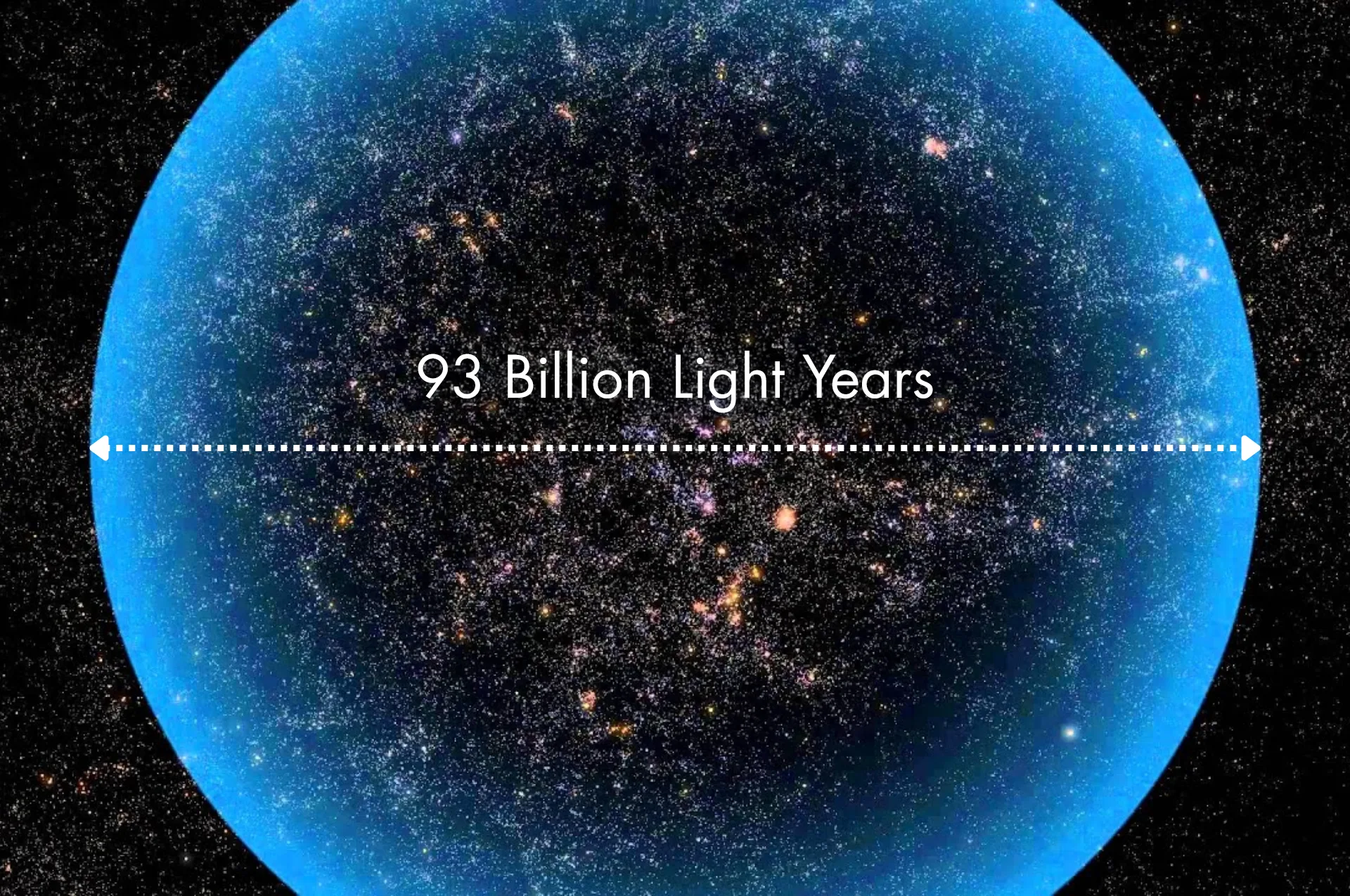
How big is the observable universe? The answer is far larger than its age might make you expect. Although the universe is about 13.8 billion years old, the observable universe spans roughly 93 billion light-years across.
The observable universe is the part of the cosmos from which light or other information has had enough time to reach us. But it is important to understand that this is not necessarily the entire universe. Beyond the region we can currently observe, there may be vastly more space that remains hidden from view.
The Size of the Observable Universe
The universe is about 13.8 billion years old, so you might expect the observable universe to be only 13.8 billion light-years across. Surprisingly, that is not the case. NASA describes the universe as approximately 13.8 billion years old, based on measurements of its expansion and other cosmological observations.
The observable universe is roughly 93 billion light-years across, with a present-day radius of about 46.5 billion light-years.
This enormous difference exists because space itself has been expanding while ancient light has been traveling toward us.
A light-year is the distance light travels in one year. Because light moves at about 300,000 kilometres per second, a single light-year already represents an enormous distance. Multiply that across tens of billions of light-years and the scale becomes almost impossible to picture.
But the 93-billion-light-year figure does not mean scientists have discovered that the universe ends there. It describes only the approximate size of the region observable from our location.
Why Can We Only See So Far?
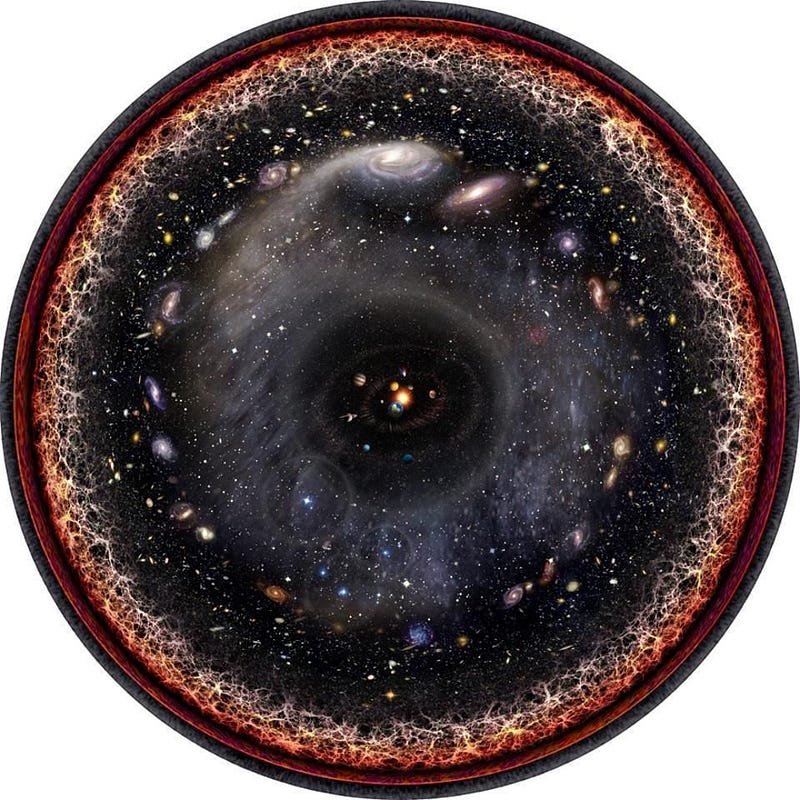
Artistic visualization of the observable universe, showing galaxies and large-scale cosmic structure surrounding our local cosmic neighborhood. Credit: Pablo Carlos Budassi
The main reason is simple: light takes time to travel.
When you look at the Moon, you see it as it was about 1.3 seconds earlier. When you look at the Sun, you see it roughly 8 minutes in the past. When astronomers observe galaxies billions of light-years away, they are seeing those galaxies as they existed billions of years ago.
This means looking deeper into space is also looking further into the past.
We explore this idea in more detail in our article How Do Telescopes See Into the Past?
The most powerful telescopes allow scientists to observe extremely distant galaxies and study some of the earliest stages of cosmic history. NASA explains that Webb can observe galaxies whose light has traveled for more than 13 billion years, allowing astronomers to see them as they appeared only a few hundred million years after the Big Bang.
NASA: How Webb Studies the Early Universe
There is another reason the observable universe is so large: space itself is expanding. While ancient light travels toward Earth, the space between us and its source continues to stretch. The object that emitted that light can therefore be much farther away today than the distance its light originally traveled.
Is There Something Beyond the Observable Universe?
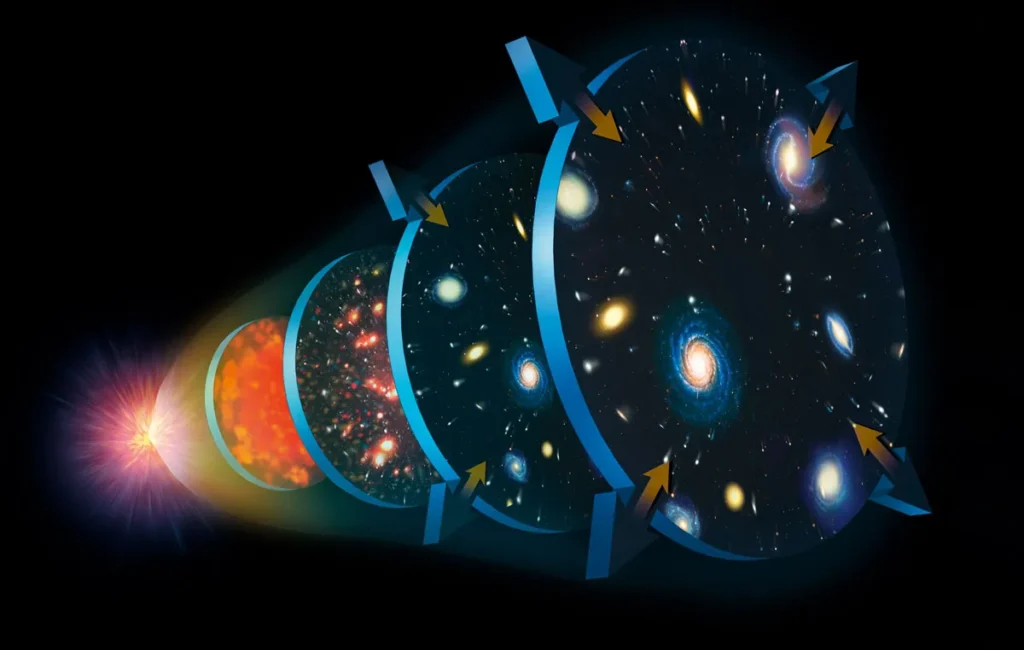
Diagram illustrating the expansion of the universe, showing cosmic structures and galaxies becoming increasingly separated as space expands. Credit: Getty images
This is where things become especially fascinating.
The edge of the observable universe is not a physical wall. There is no boundary where space suddenly stops. It is an observational horizon — a limit created by the finite age of the universe and the time light takes to travel.
Imagine standing in a huge field on a foggy morning. You can see only as far as the fog allows. The point where your vision stops does not mean the field ends there. It simply means you cannot currently see beyond it.
The universe is similar.
There may be enormous regions beyond our observable universe whose light has never reached us. If the accelerated expansion of the universe continues, some sufficiently distant regions may remain permanently beyond what we can observe.
Scientists do not currently know the total size of the universe. It could be vastly larger than the observable region, and cosmological models also allow the possibility that the entire universe could be infinite. Measurements indicate that the universe is very close to spatially flat on the largest scales, but that alone does not reveal its total size.
What Can We Actually See?
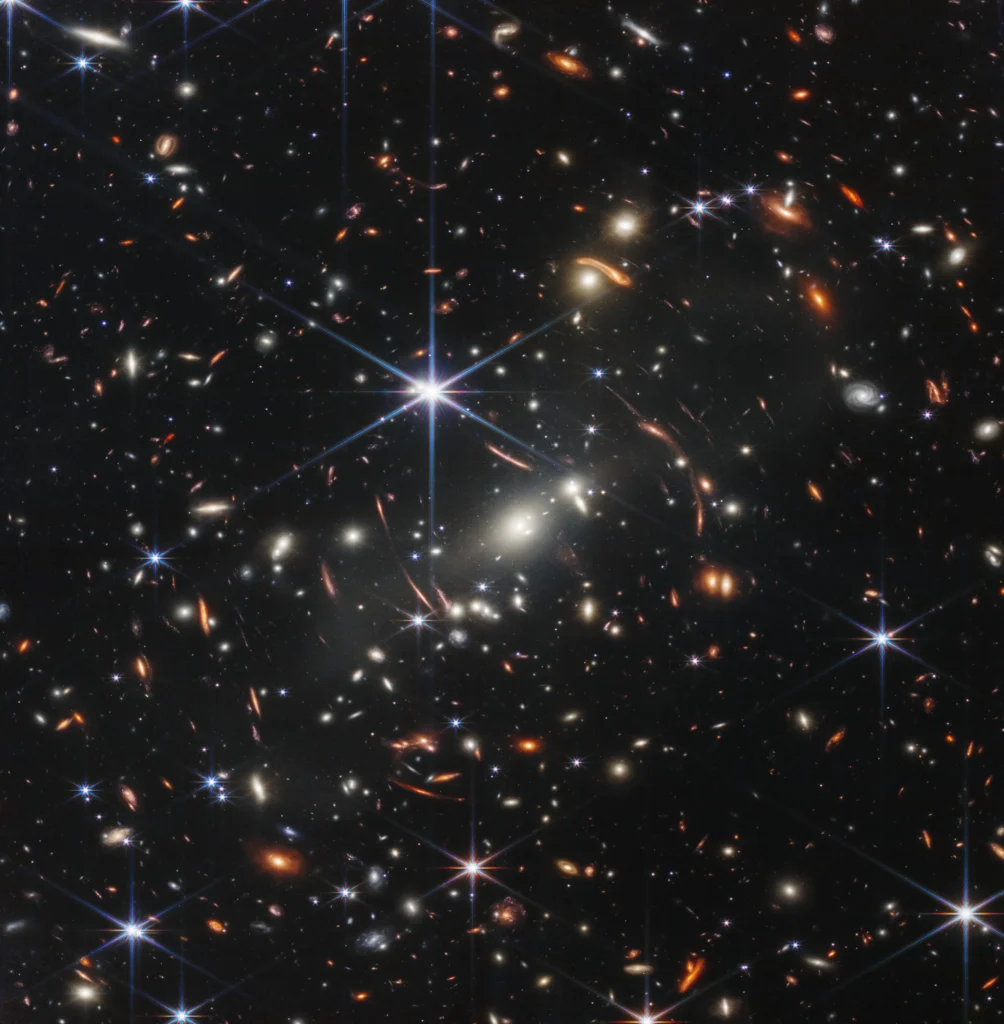
Webb’s First Deep Field reveals the galaxy cluster SMACS 0723, surrounded by thousands of distant galaxies and gravitationally lensed arcs of light. Credit: NASA, ESA, CSA, STScI, Webb ERO Production Team
The observable universe contains galaxies, stars, planets, gas, dust, dark matter and enormous structures extending across billions of light-years.
When telescopes such as Hubble and the James Webb Space Telescope look deep into space, they detect distant galaxies whose light has traveled for billions of years. Astronomers are therefore observing different chapters in cosmic history rather than seeing every galaxy as it exists today.
Webb has already observed galaxies from only a few hundred million years after the Big Bang. NASA reports that some galaxies studied by Webb existed when the universe was approximately 400 to 600 million years old.
These observations help astronomers understand how the first generations of galaxies formed and how the young universe evolved.
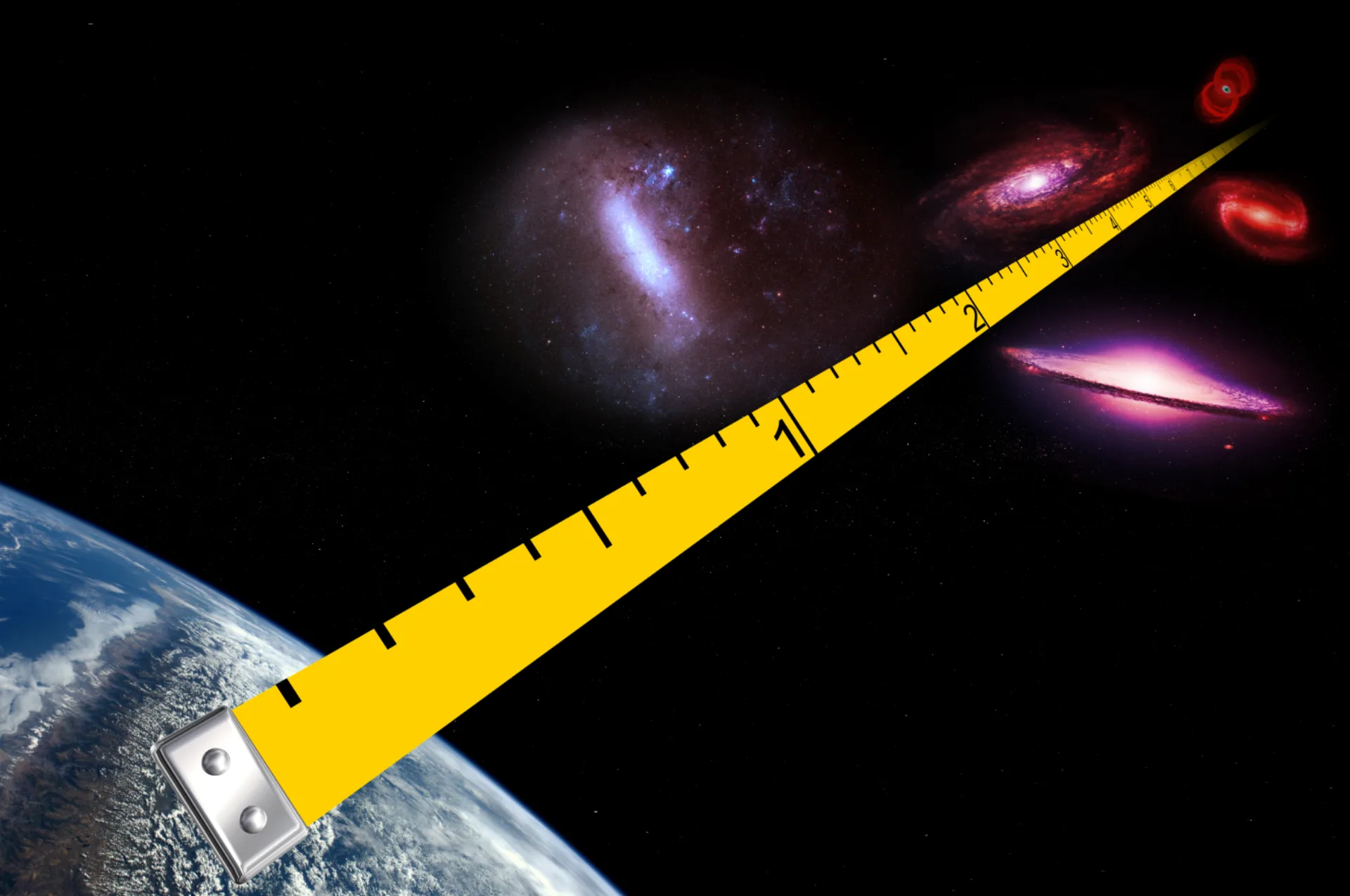
Determining just how far away these galaxies are requires techniques such as redshift measurements and spectroscopy, which we explain in How Do Astronomers Measure the Distance to Stars and Galaxies?
Yet even the most advanced telescope cannot simply see beyond the current observable horizon. A telescope can collect extraordinarily faint light, but that light must first have had enough time to reach us.
So How Much of the Universe Can We See?
The honest answer is that we can observe only a limited portion of the entire cosmos.
That portion is the observable universe, which is roughly 93 billion light-years across today. It sounds unimaginably large — because it is — but scientists still cannot say how large the entire universe really is.
There could be vastly more beyond everything we can currently observe. There may be galaxies, structures and enormous regions of space beyond our cosmic horizon.
And that may be one of the strangest things about the universe.
We can look more than 13 billion years into the past, detect galaxies from the earliest eras of cosmic history and map structures across billions of light-years — while still having no way to see the universe in its entirety.
The observable universe is therefore not a map of everything that exists. It is simply the part of reality that cosmic history has allowed us to observe so far.
Look Up. Observe Vastness.
LUOV