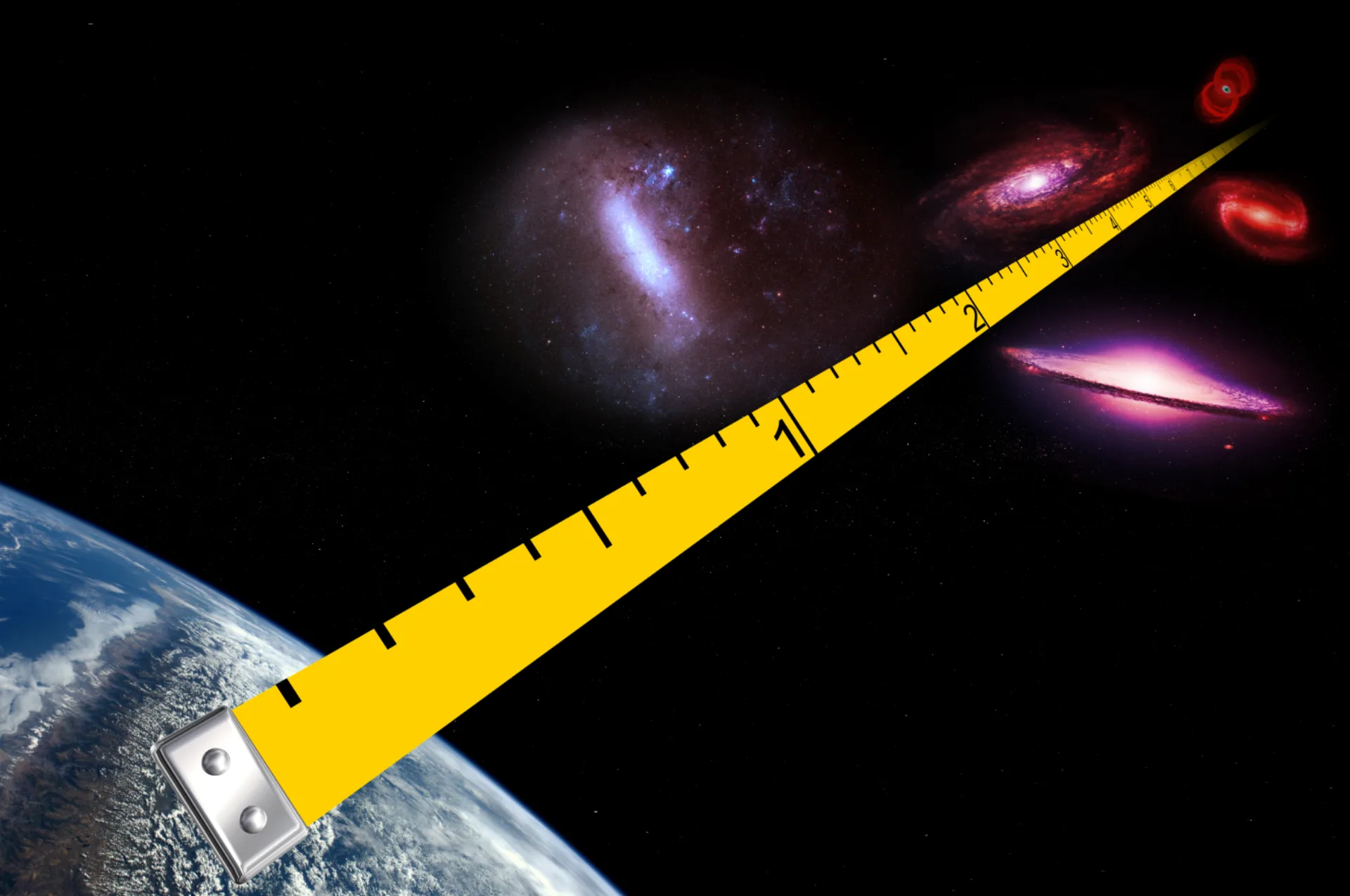
How can scientists possibly know how far away a star is when it is trillions of kilometers from Earth? And how can they measure the distance to an entire galaxy that is millions or even billions of light-years away?
Understanding how astronomers measure distance begins with light. Astronomers cannot travel to distant stars and galaxies with a ruler. Instead, they observe their light and use several different techniques depending on how far away an object is.
From the tiny apparent movement of nearby stars to the redshift of distant galaxies, these methods form what astronomers call the cosmic distance ladder.
How Astronomers Measure Distance With Parallax
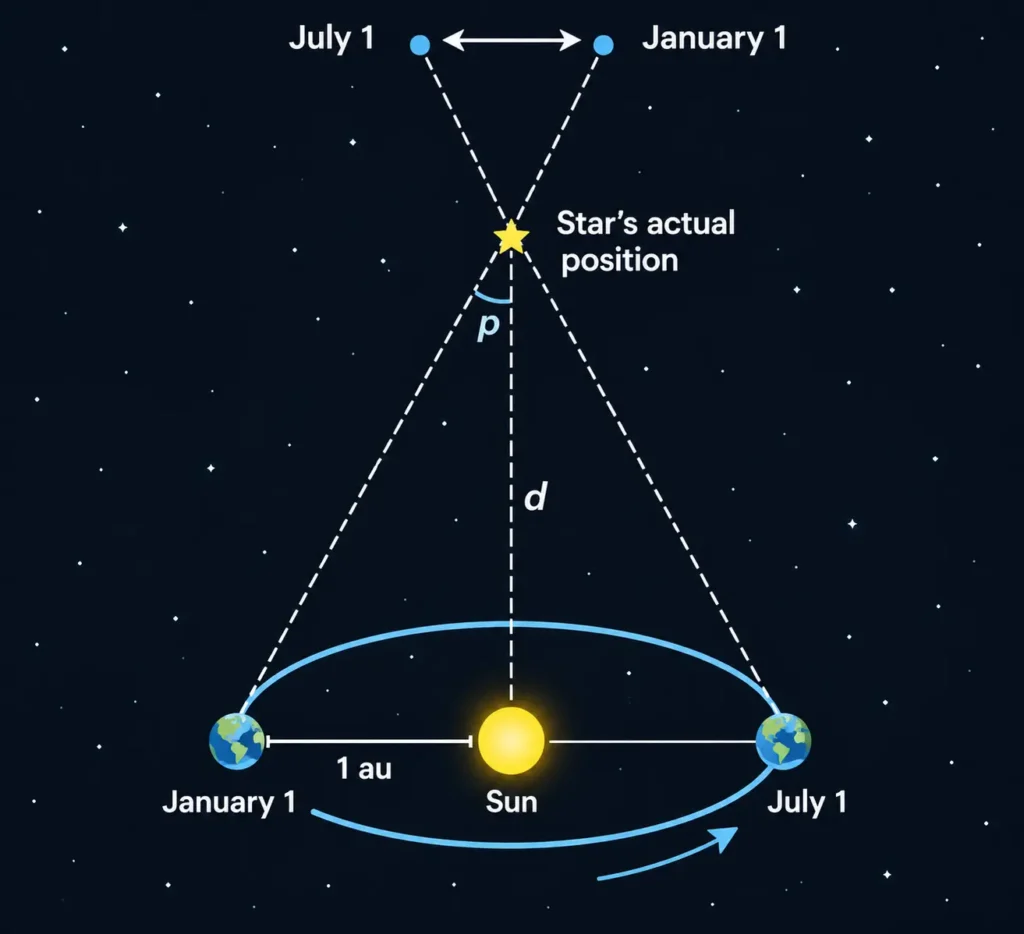
Diagram illustrating stellar parallax, where Earth’s changing position in orbit causes a nearby star to appear to shift against more distant background stars.
For relatively nearby stars, one of the most important methods is parallax.
It works much like holding your thumb in front of your face and looking at it first with one eye and then the other. Your thumb appears to shift against the background because your viewpoint has changed.
Astronomers use the same principle on a much larger scale. As Earth moves around the Sun, a nearby star appears to shift slightly relative to much more distant stars. The larger this apparent movement, the closer the star is.
By measuring this extremely small parallax angle and knowing the size of Earth’s orbit, astronomers can calculate the star’s distance using geometry. ESA’s Gaia mission used this principle to measure stellar distances and build an extraordinarily detailed three-dimensional map of our galactic neighborhood. How Gaia measures stellar distances with parallax
Parallax becomes increasingly difficult as stars get farther away because their apparent movement becomes extremely small.
Astronomers therefore use special units for these enormous distances. One parsec equals about 3.26 light-years, while a light-year is the distance light travels in one year — roughly 9.46 trillion kilometers.
How Astronomers Measure Distance to Faraway Stars
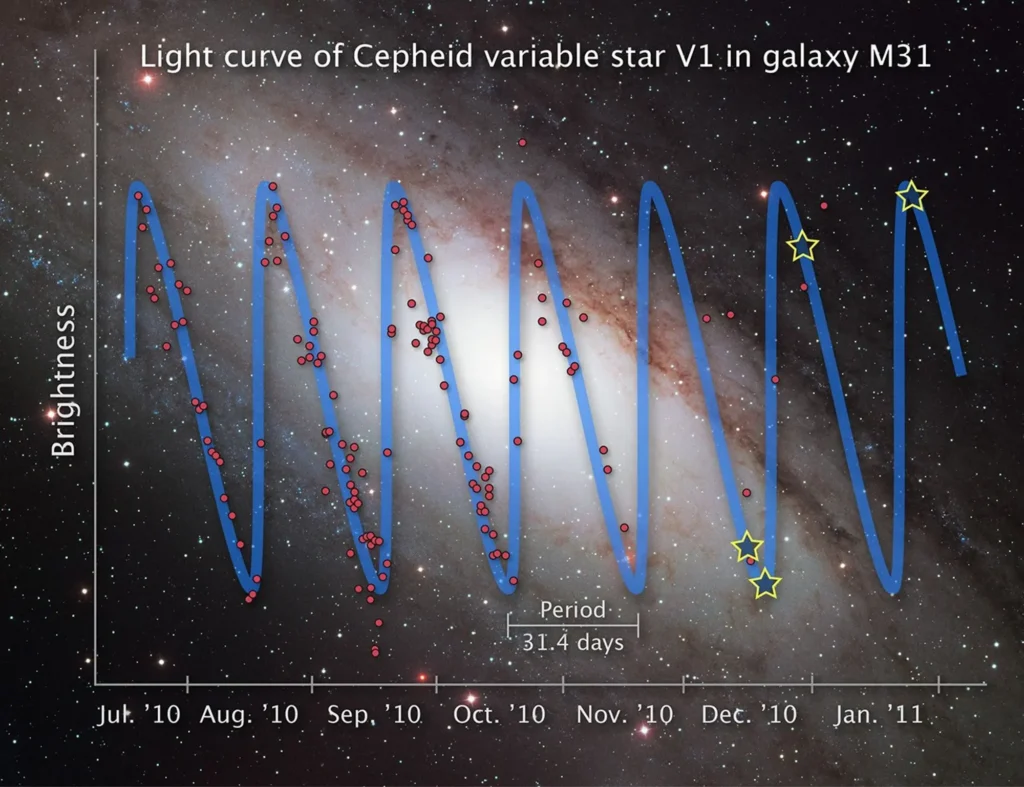
Graph showing the 31.4-day brightness cycle of Cepheid variable star V1 in the Andromeda Galaxy, illustrating how Cepheid pulsations can be used to estimate cosmic distances. Credit: NASA
When a star is too distant for a reliable parallax measurement, astronomers can use objects whose intrinsic brightness can be determined.
One of the most important examples is a Cepheid variable star.
Cepheids repeatedly become brighter and dimmer in a predictable pattern. Crucially, the time it takes a Cepheid to complete one pulsation is related to its true luminosity. By measuring this period, astronomers can determine how bright the star actually is.
They can then compare its intrinsic brightness with how bright it appears from Earth.
If an intrinsically bright star appears very faint, it must be far away. This allows astronomers to calculate its distance.
Cepheid variables therefore act as standard candles — astronomical objects whose known luminosity can serve as a cosmic measuring tool. NASA describes Cepheids as an important rung in the cosmic distance ladder used to extend measurements from nearby stars to other galaxies. NASA: The cosmic distance ladder and Cepheid variables
For even greater distances, astronomers can use other standard candles, including Type Ia supernovae, which are bright enough to be observed across enormous intergalactic distances.
How Astronomers Measure Distance to Galaxies
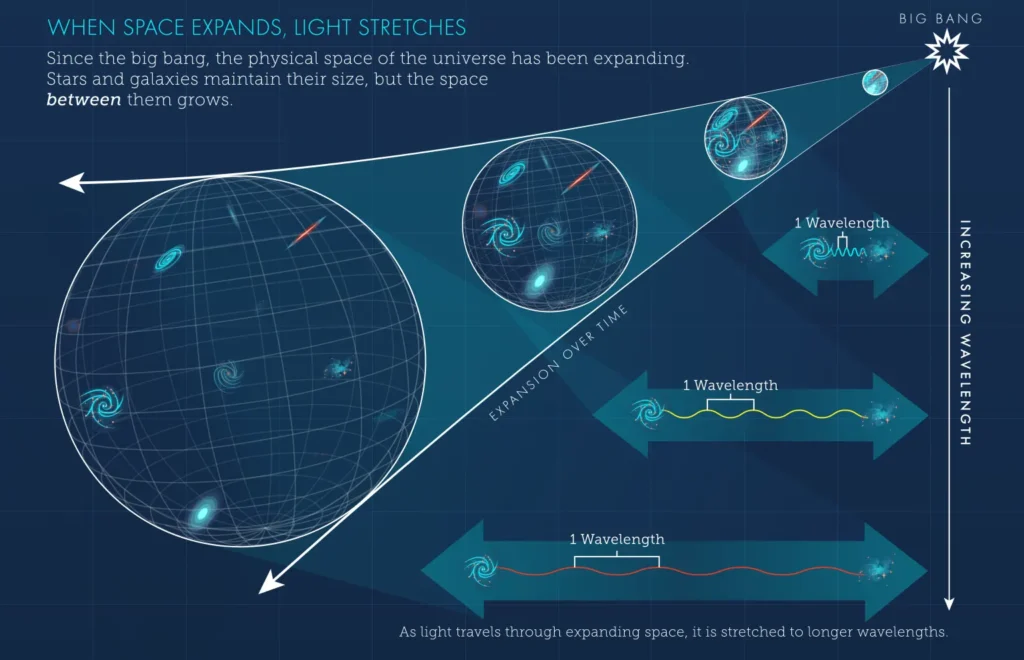
Illustration showing how the expansion of the universe stretches light from distant galaxies toward longer wavelengths, producing cosmological redshift. Credit: NASA
For very distant galaxies, redshift becomes another important tool.
As the universe expands, the space through which light travels also expands. This stretches the light from distant galaxies toward longer wavelengths, producing what is known as cosmological redshift.
Astronomers can split a galaxy’s light into a spectrum and identify recognizable spectral features. By measuring how far those features have shifted from their expected wavelengths, they can determine the galaxy’s redshift.
Redshift, combined with models of the universe’s expansion, allows astronomers to estimate enormous cosmic distances. NASA explains that spectroscopy can measure galaxy redshift and use it to investigate both distance and the expansion of the universe. NASA: Cosmological redshift and spectroscopy
Because light takes time to travel, studying increasingly distant galaxies also means looking further into cosmic history. We explore this idea in our guide to How telescopes see into the past.
How Space Telescopes Measure Cosmic Distances
Modern observatories allow astronomers to make these measurements with remarkable precision.
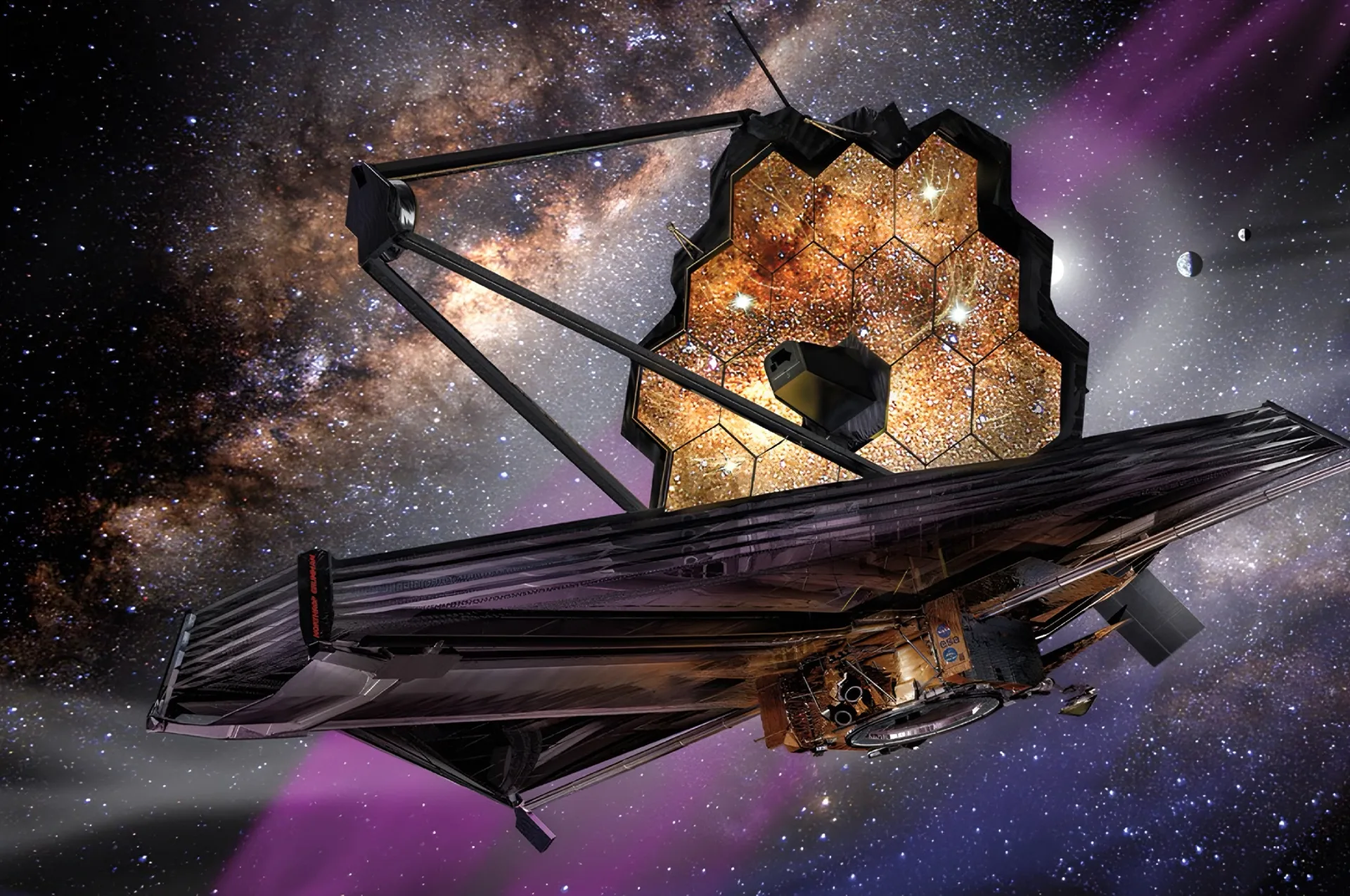
NASA’s James Webb Space Telescope can analyze extremely faint galaxies using infrared imaging and spectroscopy. Its NIRSpec instrument separates incoming light into a spectrum, allowing astronomers to identify spectral features and determine precise redshifts.
Photometric observations can provide an initial estimate of a distant galaxy’s redshift by comparing its brightness across different wavelength ranges. Spectroscopy can then provide a much more precise measurement by identifying specific features within the galaxy’s spectrum. NASA: Measuring distances to galaxies with space telescopes
Different observatories are designed to study different parts of the universe and different wavelengths of light. Our comparison of Roman, James Webb and Hubble explains how their capabilities differ. Roman vs James Webb vs Hubble
The Cosmic Distance Ladder
There is no single technique that can measure every distance in the universe.
Instead, how astronomers measure distance depends on how far away the object is. Parallax provides direct geometric measurements for nearby stars. Cepheid variables and other standard candles extend the scale farther outward. Redshift and cosmological models allow astronomers to investigate galaxies across billions of light-years.
Each technique helps calibrate or extend the next, creating the cosmic distance ladder.
Together, these methods allow scientists to map the universe, study its expansion and observe galaxies whose light began traveling toward us billions of years ago.
Understanding these enormous distances also helps astronomers reconstruct cosmic history and determine properties such as the age of the universe, which we explore in more detail here – How Do We Know the Universe Is 13.8 Billion Years Old?
Look Up. Observe Vastness.
LUOV