Credit: NASA
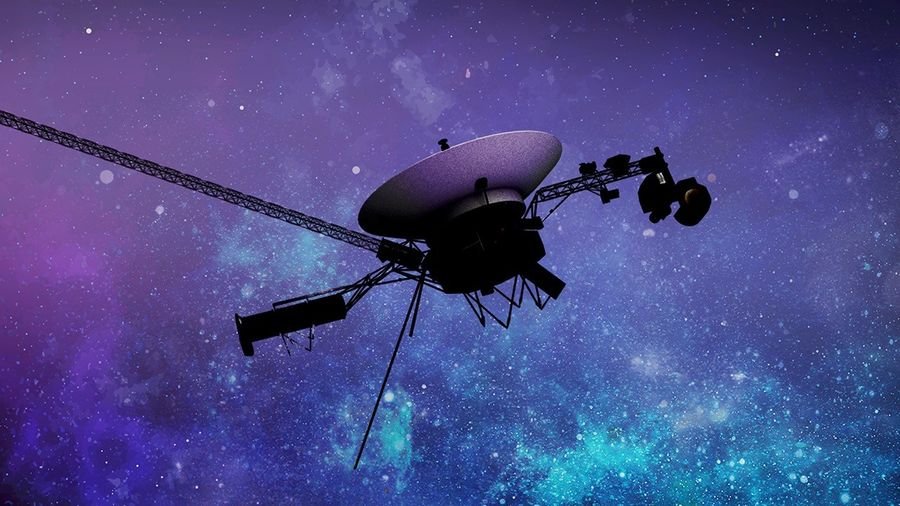
The Voyager 1 Mission is one of the most incredible adventures in human history. Launched by NASA on September 5, 1977, Voyager 1 was built to explore the giant planets of our Solar System. Few people imagined that nearly five decades later, the spacecraft would still be operating, traveling farther than any human-made object has ever gone.
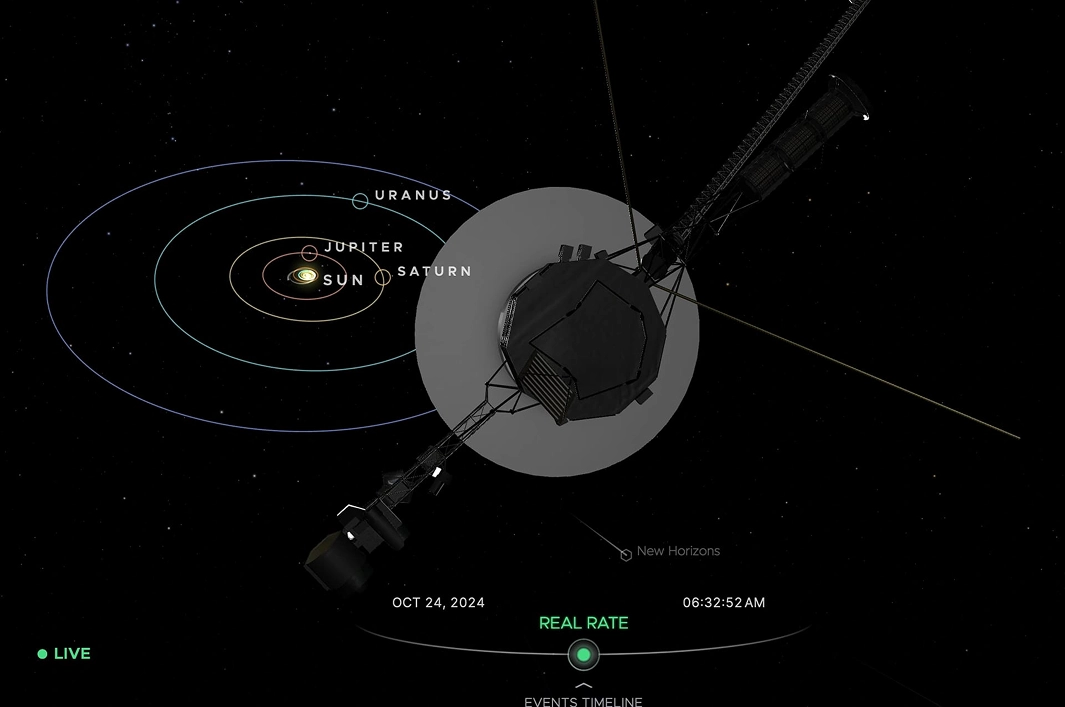
Today, Voyager 1 is more than 25 billion kilometers from Earth, moving through the dark expanse of interstellar space. It is so distant that a radio signal traveling at the speed of light takes almost a full day to reach the spacecraft. Yet despite the enormous distance, Voyager 1 continues to send faint messages back to Earth, allowing scientists to study a region of space that no spacecraft had ever explored before.
What makes the Voyager 1 Mission truly remarkable is that it represents humanity’s endless curiosity. It is a machine built by human hands, carrying our hopes, knowledge, and dreams into the vast unknown beyond the Solar System.
The Spacecraft That Exceeded Every Expectation
Credit: NASA
The Voyager 1 Mission was originally designed to study Jupiter and Saturn during a rare planetary alignment that occurs only once every 176 years. Engineers expected the spacecraft to operate for just a few years.
Instead, Voyager 1 transformed into one of the most successful scientific missions ever launched.
When it reached Jupiter in 1979, the spacecraft captured stunning images of the giant planet and discovered active volcanoes on Io, one of Jupiter’s moons. This was the first time scientists observed volcanic activity beyond Earth. Voyager 1 also revealed powerful storms, complex cloud patterns, and details about Jupiter’s magnetic environment.
A year later, it arrived at Saturn and provided breathtaking views of the planet’s rings and moons. The mission completely changed our understanding of the outer Solar System and delivered discoveries that scientists continue to study today.
After completing its planetary tour, Voyager 1 did something extraordinary. It kept going.
Crossing Into the Space Between the Stars
Credit: NASA
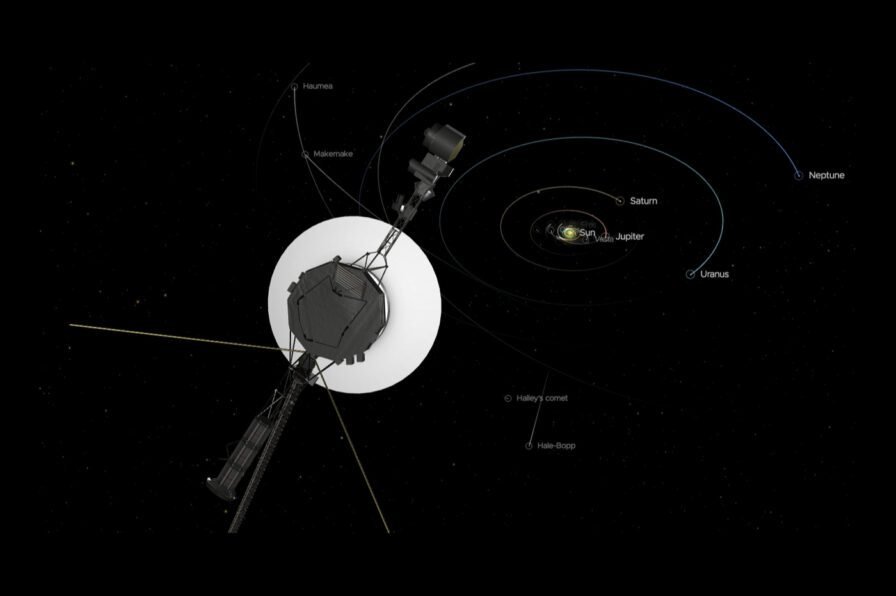
For decades, Voyager 1 continued traveling away from the Sun, heading toward the edge of our star’s influence.
In August 2012, the Voyager 1 Mission achieved one of the greatest milestones in space exploration. The spacecraft crossed the heliopause, a boundary where the solar wind from the Sun gives way to particles and magnetic fields from interstellar space.
This historic moment made Voyager 1 the first human-made object to enter interstellar space.
Although it has not completely left the Solar System’s gravitational influence, it is now exploring a region between the stars that had never been visited before. Every bit of data it sends back helps scientists understand how our Solar System interacts with the wider galaxy.
Later in 2026, Voyager 1 is expected to reach another incredible milestone by becoming the first human-made object to travel one light-day from Earth. This means even light, moving at nearly 300,000 kilometers per second, needs an entire day to cross the distance between us and the spacecraft.
The Photograph That Changed Humanity’s Perspective
Credit: NASA
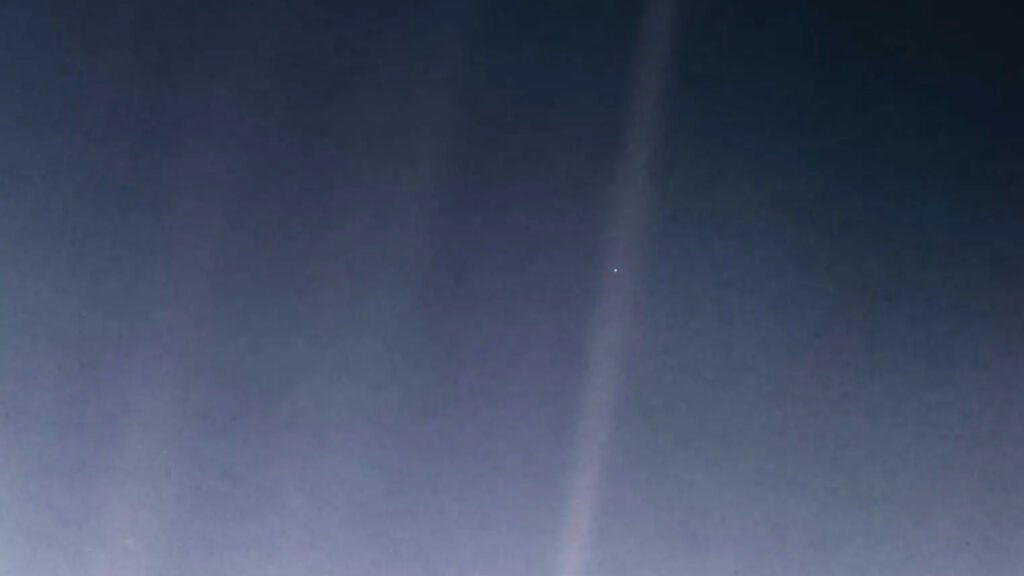
Before beginning its final journey into deep space, Voyager 1 turned its camera back toward home in February 1990. From nearly 6 billion kilometers away, it captured a photograph that would become one of the most famous images in history.
In the picture, Earth appears as a tiny speck of light floating in a beam of sunlight. The image became known as the Pale Blue Dot.
Astronomer Carl Sagan later used the photograph to remind humanity how small our world is compared to the vast universe around us. Every person who has ever lived, every civilization, every invention, every triumph, and every struggle took place on that tiny dot.
The image continues to inspire millions of people because it shows both the fragility and uniqueness of our home planet.
A Message for Future Civilizations – The Golden Record
Credit: NASA
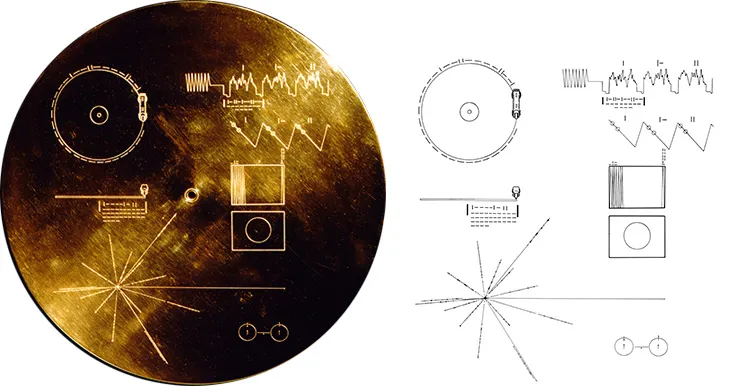
One of the most fascinating parts of the Voyager 1 Mission is the Golden Record attached to the spacecraft.
The gold-plated disk contains music, greetings, natural sounds, photographs, and cultural information from Earth. It was designed as a message from humanity to any intelligent civilization that might discover the spacecraft in the distant future.
The record includes sounds of birds, ocean waves, laughter, and greetings in dozens of languages. It also contains music from different cultures around the world, representing the diversity of life on Earth.
Even if no one ever finds it, the Golden Record stands as a powerful symbol of humanity’s desire to connect with the universe.
The Voyager 1 Mission is much more than a scientific project. It is a reminder of what humans can achieve when curiosity and exploration come together.
A spacecraft built with 1970s technology is still communicating with Earth nearly 50 years after launch. It continues to explore a region where no human made object has gone before, pushing the boundaries of knowledge with every signal it sends home.
One day, Voyager 1’s power supply will run out and its instruments will fall silent. Yet the spacecraft will continue traveling through the Milky Way for millions of years, carrying a small piece of Earth into the cosmic darkness.