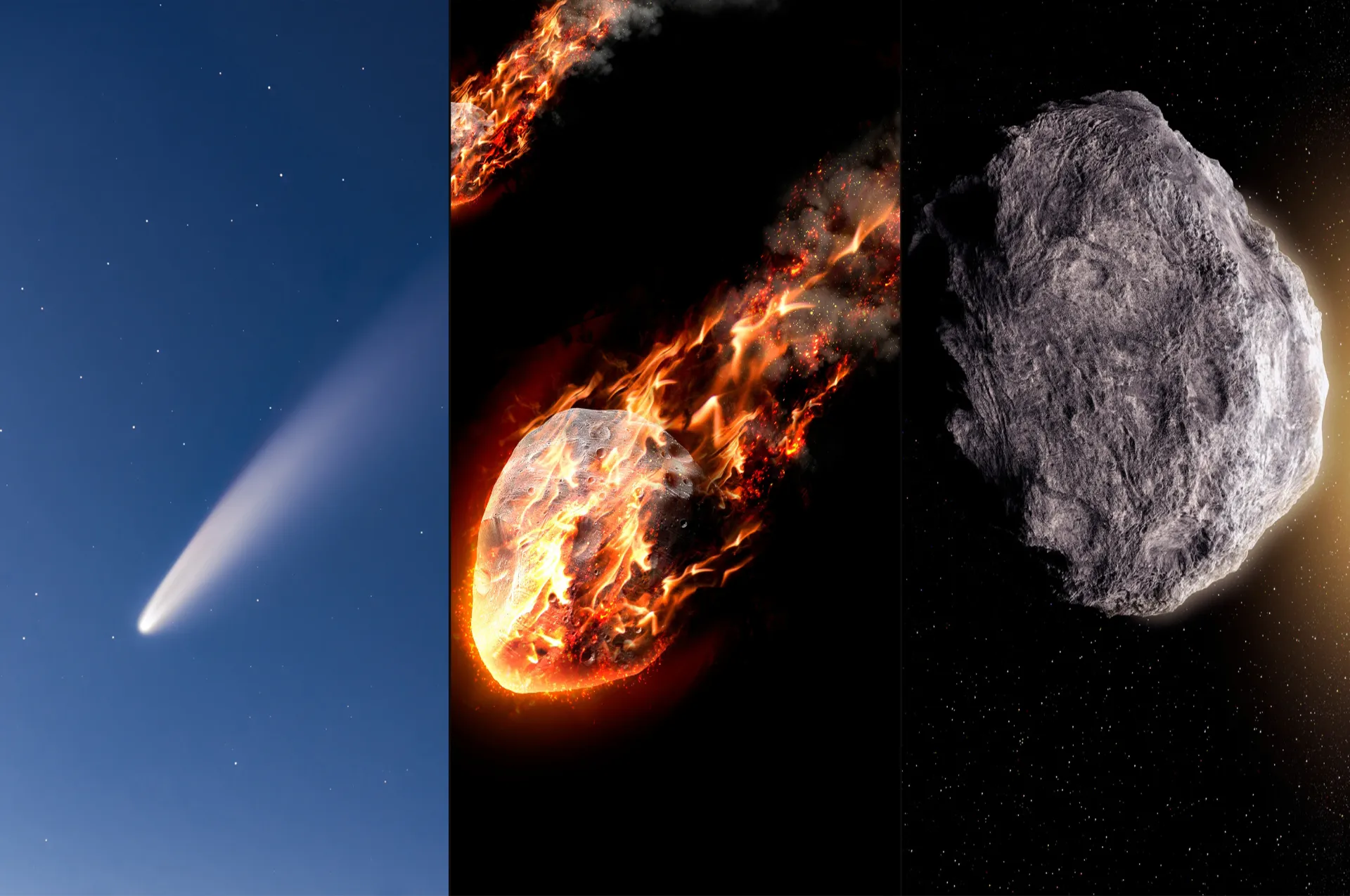
Have you ever looked up at the night sky and wondered whether you were seeing a comet, a meteor, or an asteroid? These three space objects are often confused because they all travel through our Solar System. However, they are very different in what they’re made of, where they come from, and how they behave. Understanding the Comet, Meteor and Asteroid Difference helps us learn more about the history of our Solar System and the fascinating objects that share our cosmic neighbourhood.
Although they may appear similar at first, each object has its own unique story. Comets are icy visitors that develop bright tails near the Sun, asteroids are rocky leftovers from the birth of the Solar System, and meteors are the glowing streaks we see when small space rocks burn up in Earth’s atmosphere. Let’s explore each one in detail.
What Is a Comet?
Credits: Canva/ Matteo Marchionni
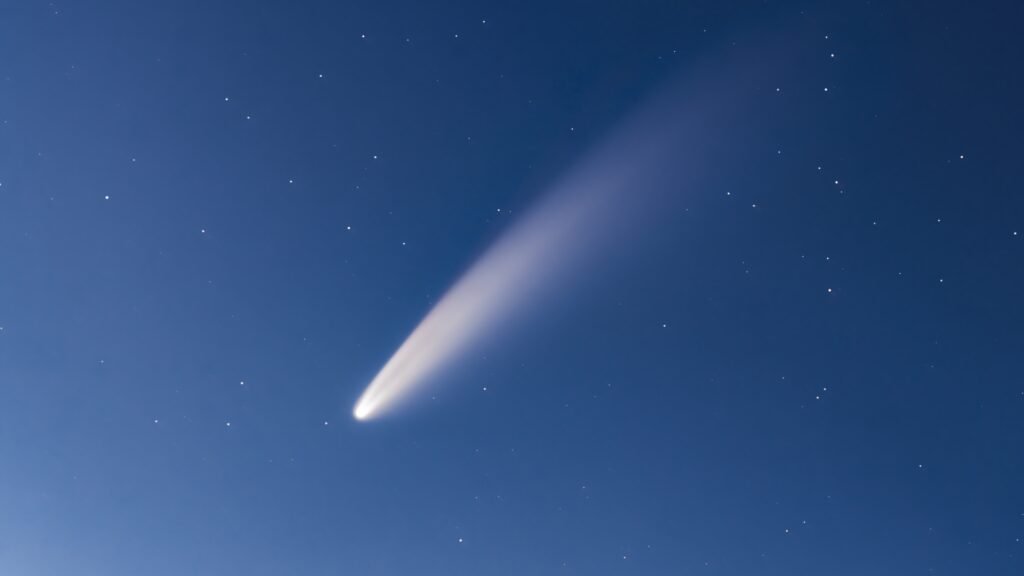
A comet is a small icy body that travels around the Sun in a long, elliptical orbit. Often called a “dirty snowball,” a comet is made of frozen water, carbon dioxide, methane, ammonia, dust, and rocky material. Most comets spend most of their lives far from the Sun, where temperatures are cold enough to keep their ice frozen.
Comets mainly originate from two distant regions of the Solar System: the Kuiper Belt, located beyond Neptune, and the much more distant Oort Cloud, a vast shell of icy objects surrounding the Solar System. These regions contain ancient material left over from the Solar System’s formation about 4.6 billion years ago.
As a comet approaches the Sun, its frozen surface begins to warm. Instead of melting into liquid, the ice changes directly into gas through a process called sublimation. This creates a glowing cloud known as the coma around the comet’s nucleus. The Sun’s radiation and the solar wind then push the gas and dust away, forming the comet’s famous tail. Interestingly, a comet’s tail always points away from the Sun, regardless of the direction it is moving.
What Is an Asteroid?
Credits: Canva / Science Photo Library
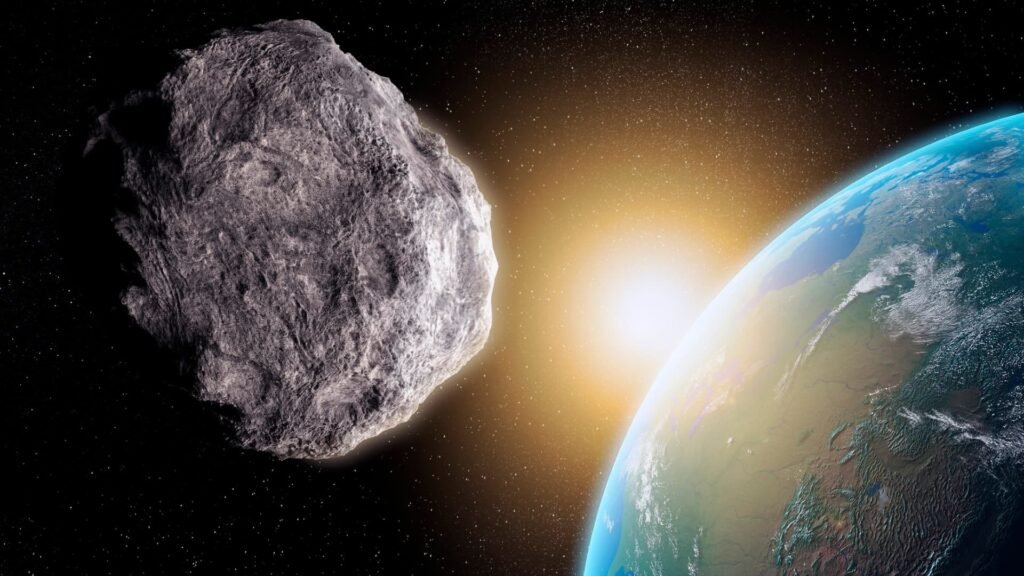
An asteroid is a rocky or metallic object that also orbits the Sun, but unlike a comet, it contains little or no ice. Because of this, asteroids do not develop glowing comas or tails when they travel through space. They are considered the leftover building blocks of the early Solar System that never formed into planets.
Most asteroids are found in the Main Asteroid Belt, a region between Mars and Jupiter containing millions of rocky objects. However, some travel much closer to our planet and are known as Near-Earth Asteroids (NEAs). Scientists carefully monitor these objects to understand whether any could pose a future impact risk.
Astronomers classify asteroids into different groups based on their composition. C-type asteroids are rich in carbon and are the most common. S-type asteroids contain silicate rocks, while M-type asteroids are rich in metals such as iron and nickel. Famous asteroids include Vesta, Pallas, and Bennu, while Ceres, the largest object in the asteroid belt, is now classified as a dwarf planet.
What Is a Meteoroid?
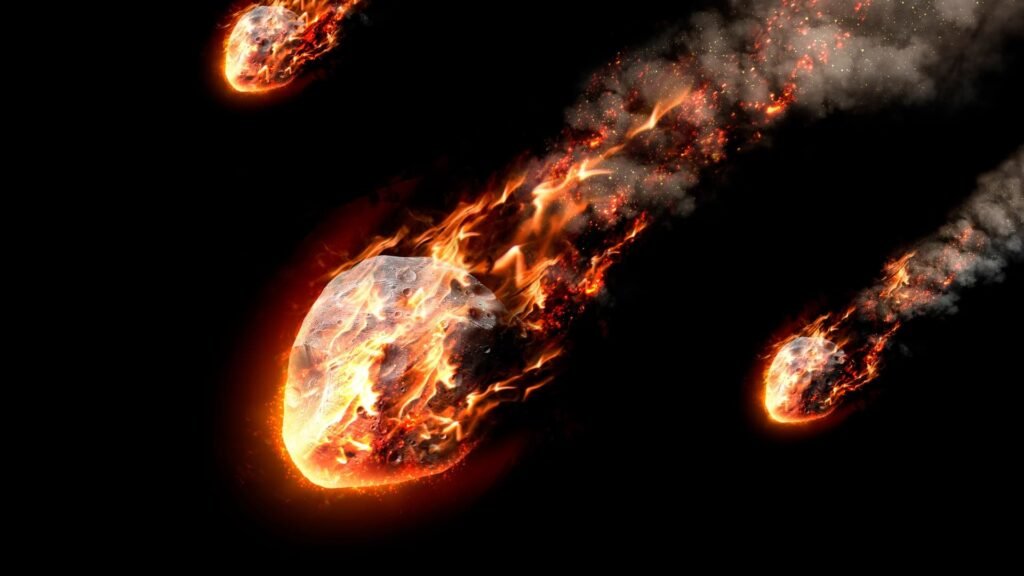
Many people use the terms meteoroid, meteor, and meteorite interchangeably, but they actually describe different stages of the same object. Understanding these terms is an important part of learning the Comet, Meteor and Asteroid Difference.
A meteoroid is a small piece of rock or metal traveling through space. Most meteoroids are fragments that broke away from asteroids during collisions, while others are pieces of debris left behind by comets. They range in size from tiny dust particles to objects several meters across.
What Is a Meteor?
A meteor is the bright streak of light produced when a meteoroid enters Earth’s atmosphere at extremely high speed. As it rushes through the air, friction and compression heat the surrounding gases, causing the meteoroid to glow brightly. This glowing trail is commonly called a shooting star, even though it has nothing to do with actual stars.
Most meteors burn up completely before reaching the ground. Every day, millions of tiny meteoroids enter Earth’s atmosphere, but nearly all of them disappear before they can be seen.
What Is a Meteorite?
If part of a meteoroid survives its journey through the atmosphere and lands on Earth’s surface, it is called a meteorite. Meteorites are valuable to scientists because they preserve material from the early Solar System, helping researchers study how planets formed billions of years ago.
What Are Meteor Showers?
Meteor showers occur when Earth passes through streams of dust and debris left behind by a comet or, in some cases, an asteroid. As these tiny particles enter Earth’s atmosphere, they create dozens or even hundreds of meteors each hour. Popular annual meteor showers include the Perseids, Geminids, and Leonids, which attract skywatchers around the world.
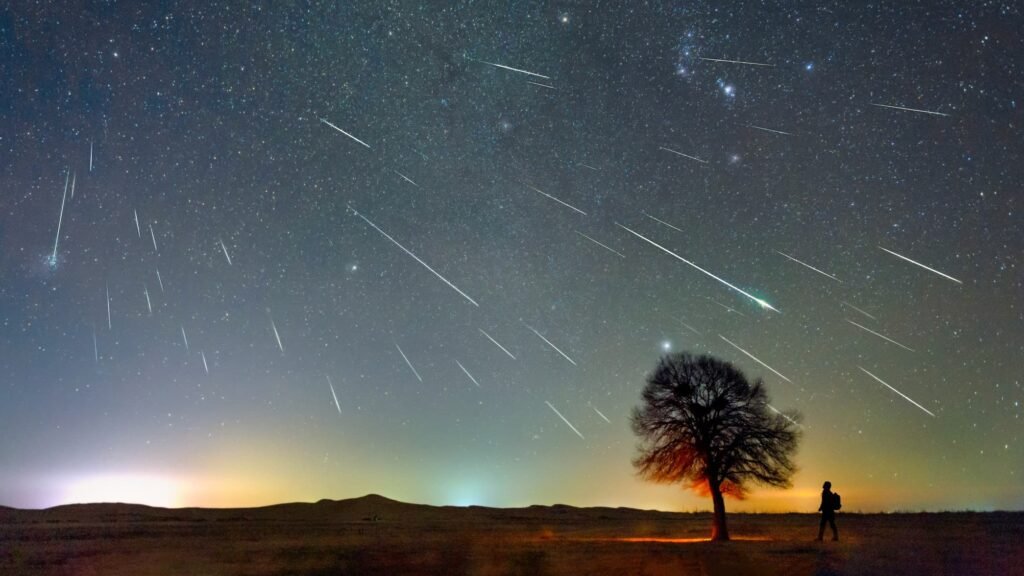
Credits: Getty Image
The easiest way to remember the Comet, Meteoroid and Asteroid Difference is by thinking about where each object exists. A comet is an icy object orbiting the Sun that develops a glowing tail when it gets close to the Sun. An asteroid is a rocky or metallic object that also orbits the Sun but does not form a tail. A meteoroid is a small rock traveling through space, a meteor is the flash of light created when that rock burns in Earth’s atmosphere, and a meteorite is the piece that survives and lands on Earth.
Although these objects are different, they all provide important clues about the formation and evolution of our Solar System. By studying them, scientists continue to uncover secrets about the materials that existed billions of years before Earth became the planet we know today.