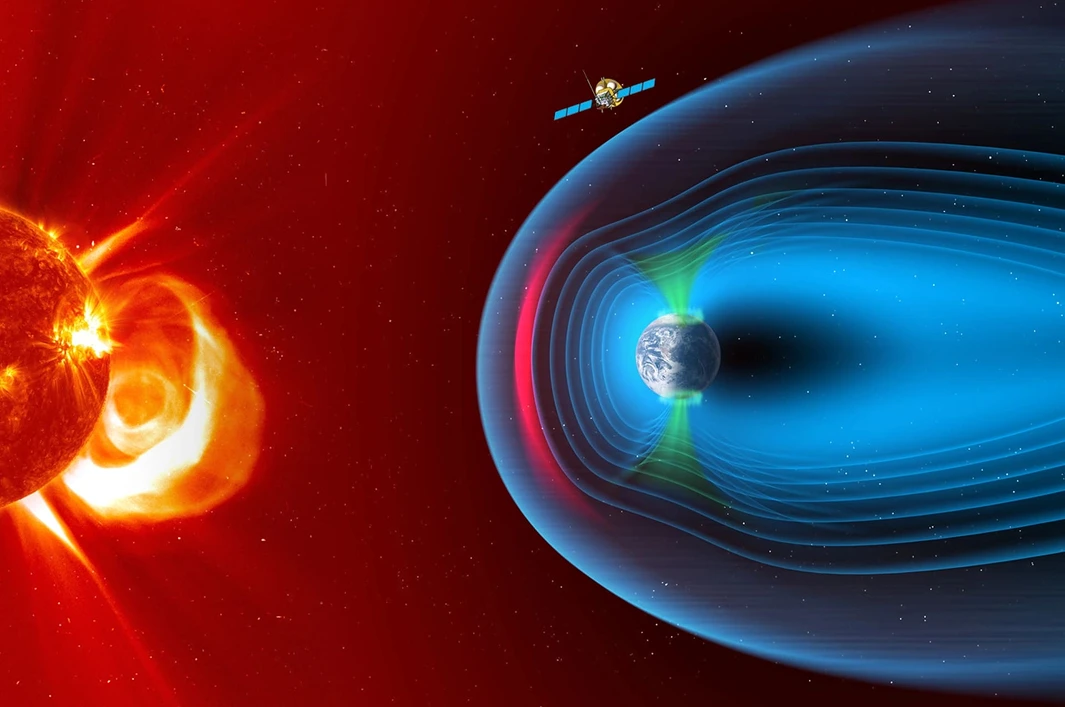
CREDIT: ESA/ATG medialab
The Smile mission is a groundbreaking space project designed to study how the Sun affects Earth’s magnetic shield. Led jointly by the European Space Agency (ESA) and the Chinese Academy of Sciences (CAS), this mission aims to give scientists the clearest global view ever of the interaction between solar wind and Earth’s magnetosphere.
Unlike earlier missions that focused on small regions or short-lived events, the Smile mission will observe the entire system at once. This will help researchers better understand space weather, solar storms, and how powerful solar activity can impact satellites, astronauts, communication systems, and even power grids on Earth.
What Is the Smile Mission?
Credit: ESA
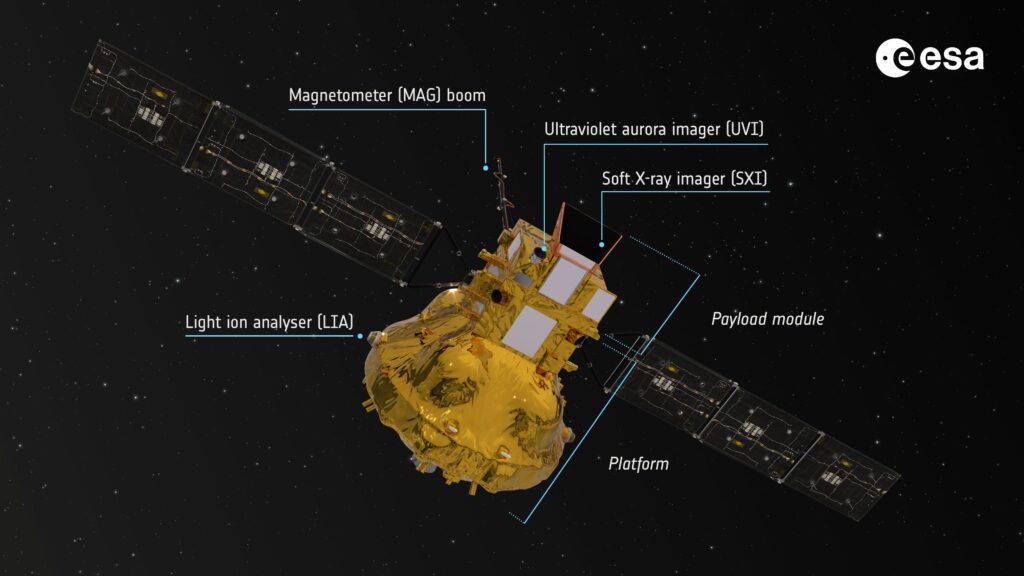
The name “Smile” stands for Solar wind Magnetosphere Ionosphere Link Explorer. The spacecraft is designed to study the invisible magnetic bubble surrounding Earth, known as the magnetosphere. This protective shield blocks most harmful charged particles coming from the Sun. Without it, life on Earth would be much more difficult.
The Smile mission uses four advanced scientific instruments to observe Earth’s space environment. Two of these instruments are imaging systems: a soft X-ray imager and an ultraviolet aurora imager. The other two measure magnetic fields and solar wind particles directly. Together, they will allow scientists to connect changes in solar activity with reactions inside Earth’s magnetic system.
One of the mission’s most exciting features is its ability to capture the first-ever X-ray images of Earth’s magnetosphere. Scientists discovered that when solar wind particles interact with neutral atoms around Earth, they produce soft X-rays. Smile will use this process to make the invisible magnetosphere visible for the first time.
How the Smile Mission Studies Space Weather
Credit: ESA
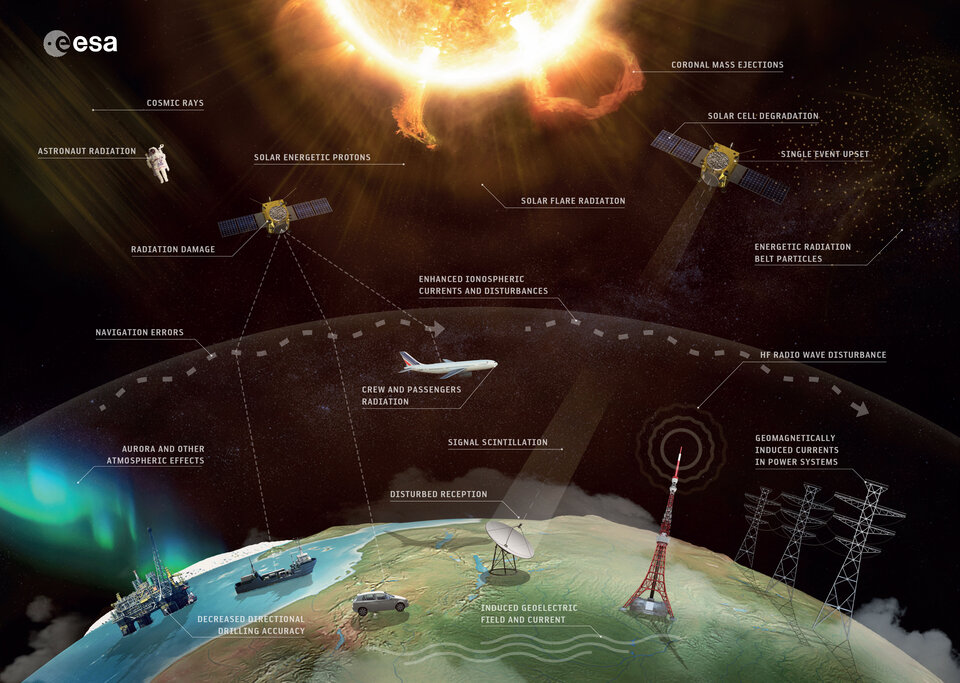
Space weather refers to disturbances caused by the Sun, including solar flares and streams of charged particles called solar wind. These events can affect satellites, GPS systems, internet communications, and astronauts in orbit. The Smile mission was designed specifically to improve our understanding of these dangerous solar events.
The spacecraft travels in a highly elliptical orbit, reaching as far as 121,000 kilometers above Earth’s North Pole. From this distant viewpoint, Smile can observe the full Sun-facing side of Earth’s magnetic shield. This wide perspective is something previous missions could not achieve easily.
Another important part of the Smile mission is its ultraviolet camera, which will continuously observe auroras for up to 45 hours at a time. Auroras form when charged solar particles travel along Earth’s magnetic field lines and collide with gases in the atmosphere near the poles. Watching these glowing lights helps scientists understand how energy from the Sun moves through Earth’s magnetic system.
Why the Smile Mission Matters
The Smile mission could significantly improve future space weather forecasting. Better predictions may help protect satellites, communication systems, aircraft navigation, and astronauts from harmful solar storms. Scientists also hope the mission will answer major questions about how Earth’s magnetic shield changes during solar activity.
The mission is also historically important because it marks the first fully joint space science mission between ESA and China. More than 250 scientists from Europe and China worked together to develop the spacecraft and its instruments.
On May 19th, 2026, the Smile mission successfully launched aboard a Vega-C rocket from French Guiana, beginning its journey to explore the invisible connection between the Sun and Earth. Over its planned three-year mission, Smile is expected to provide valuable scientific data that could reshape our understanding of near-Earth space.