Imagine a machine launched from Earth nearly 50 years ago, still traveling through the darkness between the stars.
That machine is Voyager 1, and it is farther from Earth than anything humanity has ever built. If you are wondering where is Voyager 1 now, the spacecraft is currently traveling through interstellar space, beyond the heliosphere — the enormous bubble of particles and magnetic fields created by the Sun.
Voyager 1 remains the most distant human-made object and continues communicating with NASA’s Deep Space Network nearly five decades after its launch in September 1977.
Where Is Voyager 1 Now in Space?
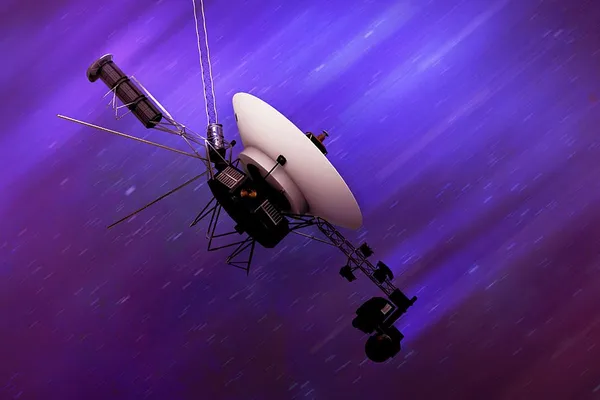
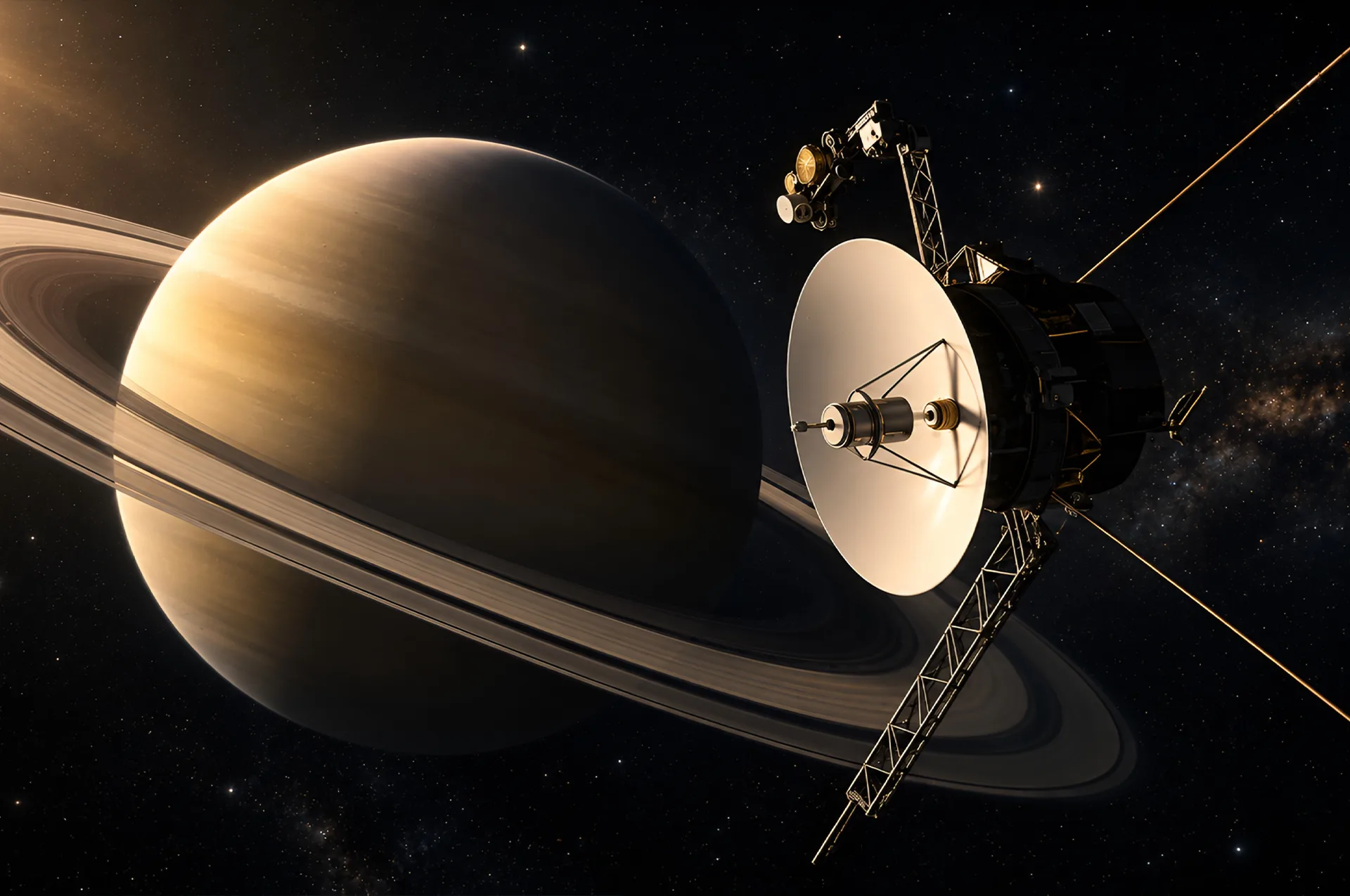
Artist’s illustration of NASA’s Voyager 1 spacecraft continuing its journey through deep space beyond the heliosphere. Credit: NASA / JPL
Voyager 1 crossed the heliopause on August 25, 2012, becoming the first spacecraft to enter interstellar space. The heliopause marks the outer boundary of the heliosphere, where the influence of the solar wind gives way to the surrounding interstellar environment.
Being in interstellar space does not necessarily mean Voyager 1 has passed beyond every definition of the Solar System.
Far beyond the planets lies the Oort Cloud, a vast region of icy objects still gravitationally connected to the Sun. NASA estimates Voyager 1 could take roughly 300 years just to reach its inner edge and tens of thousands of years to travel beyond it.
Voyager 1 is escaping the Solar System at about 3.5 astronomical units per year and is traveling generally toward the constellation Ophiuchus.
Where Is Voyager 1 Now Compared With Earth?
Voyager 1 is currently approaching another extraordinary milestone: becoming the first human-made object to reach a distance of one light-day from Earth.
NASA projects that this will happen on November 18, 2026, when Voyager 1 will be about 16.094 billion miles (25.902 billion kilometers) from Earth.
NASA: Voyager 1’s one-light-day milestone
A light-day is simply the distance light travels in 24 hours.
This also shows just how difficult communication with Voyager has become. Radio signals travel at the speed of light, so once Voyager reaches that milestone, a command sent from Earth will take approximately 24 hours to reach the spacecraft. Any response then needs roughly another 24 hours to return.
A simple exchange between Earth and Voyager 1 will therefore involve a communication round trip of about two days.
What Is Voyager 1 Doing Now?
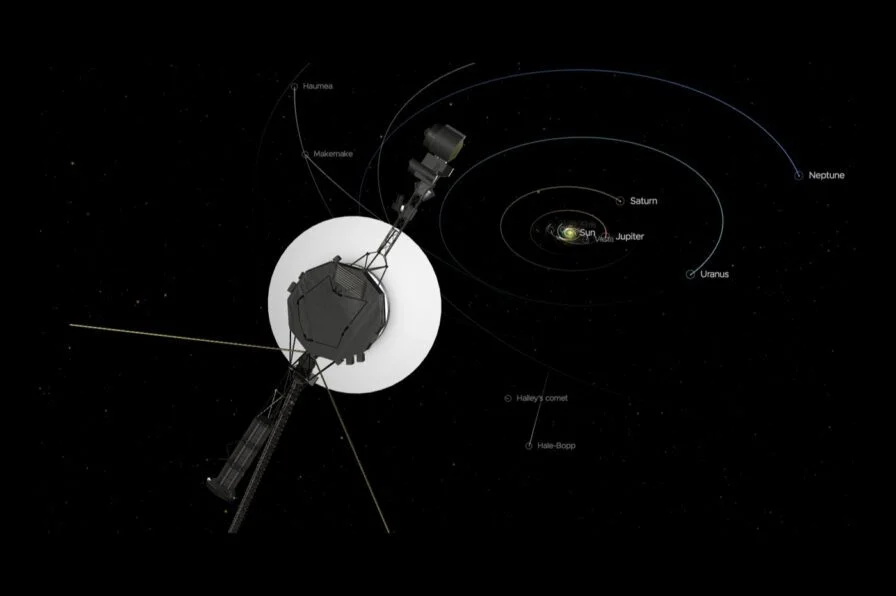
Visualization showing Voyager 1 traveling far beyond the planets as it continues outward through interstellar space. Credit: NASA
Voyager 1 was originally built to explore the outer planets. During its primary mission, it made historic flybys of Jupiter and Saturn before beginning its long journey toward interstellar space.
Today, its mission is very different.
Because the spacecraft has traveled beyond the heliosphere, it can directly measure conditions in the interstellar environment — a region no other operating spacecraft has reached.
But Voyager 1’s power supply has been steadily declining. Its radioisotope power system produces less electricity each year, forcing engineers to gradually shut down instruments in order to extend the mission.
On April 17, 2026, NASA switched off Voyager 1’s Low-Energy Charged Particles experiment. The spacecraft now has two operating science instruments: its magnetometer and plasma wave subsystem. Both continue returning scientific data from interstellar space.
NASA: Voyager 1 instrument status
The fact that any scientific instruments are still operating nearly 50 years after launch is remarkable. Voyager 1 was never originally designed for a mission lasting this long.
Where Is Voyager 1 Now Heading?
Voyager 1 is not heading toward another planet or a star it will reach anytime soon.
Space between stars is simply too enormous.
In roughly 40,000 years, Voyager 1 is expected to pass within about 1.7 light-years of a star known as AC +79 3888, or Gliese 445.
Even then, it will not pass particularly close by astronomical standards.
Long before that happens, Voyager 1 will eventually lose the ability to communicate with Earth. But the spacecraft itself will continue traveling through the Milky Way.
It also carries one of humanity’s most unusual messages: the Voyager Golden Record, a gold-plated copper disc containing images, sounds, music and greetings intended to represent life and culture on Earth.
For the wider story of the mission — from its launch and planetary encounters to its journey beyond the heliosphere — read our article Voyager 1: The Farthest Human-Made Object Ever Sent.
Look Up. Observe Vastness.
LUOV