The best time to stargaze is usually on a clear, dark night with little moonlight and minimal light pollution. But simply waiting for the Sun to set is not always enough. The Moon’s phase, weather conditions, darkness, and your location can all dramatically affect how much you see in the night sky.
Whether you are hoping to spot constellations, the Milky Way, planets, or a meteor shower, understanding these factors can help you choose the right night to look up.
Why Moon Phase Matters for the Best Time to Stargaze
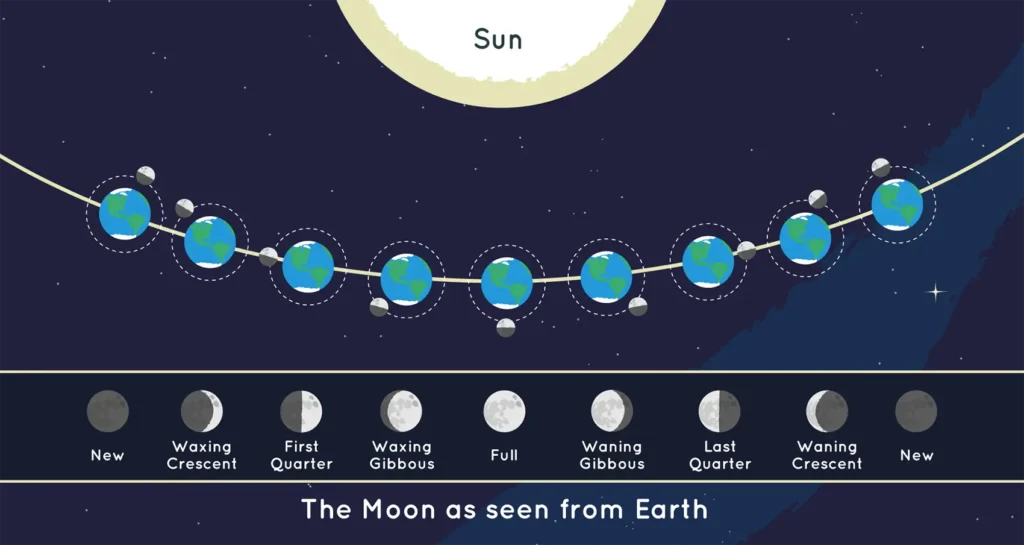
Illustration showing how the Moon’s position around Earth creates the different lunar phases visible from our planet. Credit: NASA
For most types of deep-sky observing, the best time to stargaze is usually around a new moon, or on nights when the Moon is below the horizon.
A bright Moon creates natural skyglow that can hide faint stars, the Milky Way, galaxies, and many meteors. NASA notes that the week around a full Moon can significantly reduce the visibility of faint objects, while nights closer to the new Moon generally provide much darker skies.
However, moonlight is not always a disadvantage. If your goal is to observe the Moon itself, different lunar phases can actually reveal more surface detail than a full Moon. Shadows along the boundary between light and darkness make mountains, valleys, and craters easier to distinguish.
For more information about choosing dark observing conditions, NASA has a useful guide to finding good places to stargaze.
Best Time to Stargaze After Sunset
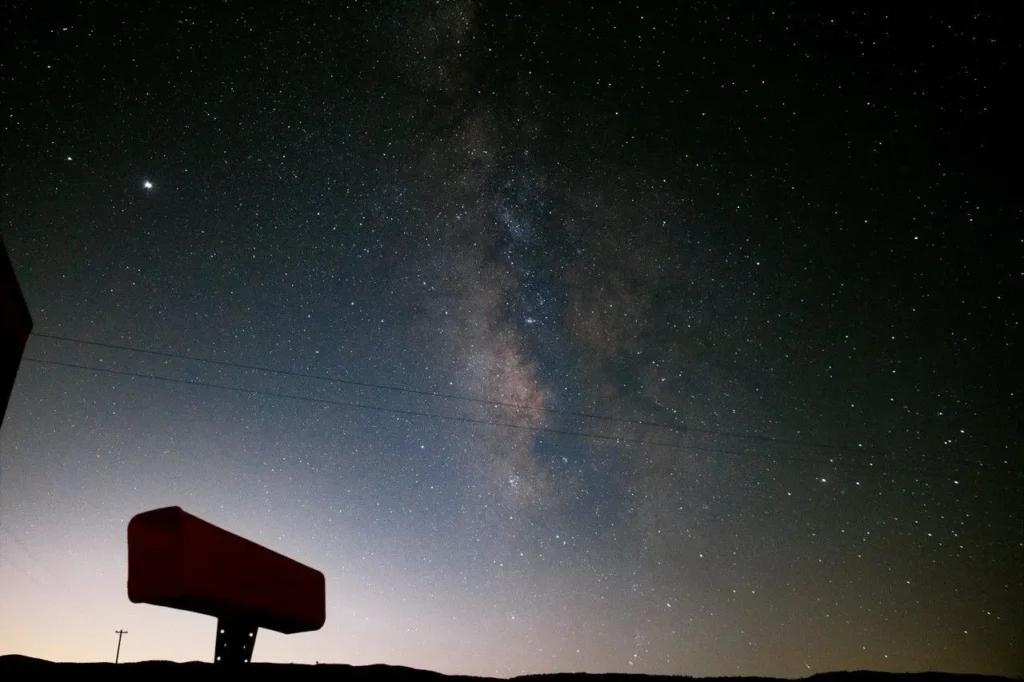
The Milky Way photographed above Antelope Valley, showing how artificial light near the horizon affects the visibility of the night sky. Credit: NASA/Preston Dyches
Darkness does not arrive immediately after the Sun disappears below the horizon. Twilight continues after sunset as sunlight still illuminates Earth’s upper atmosphere.
For faint stars and deep-sky objects, it is generally worth waiting until the sky becomes fully dark. Bright planets and major constellations may become visible much earlier, while the Milky Way, faint star clusters, and dimmer objects benefit from deeper darkness.
The exact best time to stargaze also depends on what you want to observe. A planet, constellation, or section of the Milky Way may only be well positioned during certain hours, so checking when your target rises and sets can make an observing session much more successful.
Your eyes also need time to adjust to darkness. NASA says full dark adaptation can take around 30 minutes or more. Looking at bright phone screens or white flashlights during this time can temporarily reduce your night vision. Dim red lights are a much better choice because they have less effect on your ability to see faint objects.
Weather Conditions Can Make or Break Stargazing
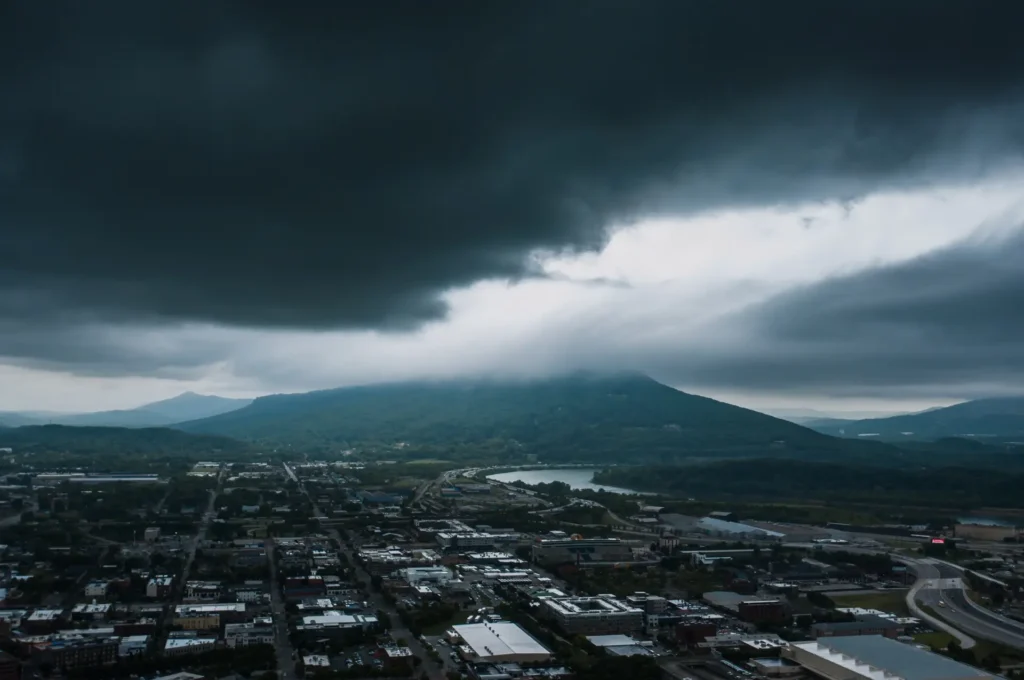
Thick clouds over an urban landscape demonstrate how weather can completely block stars and other objects in the night sky. Credit: Canva
Even the best time to stargaze can be ruined by poor weather.
Clouds are the most obvious problem because they can partially or completely block the night sky. Before heading outside, check the forecast for cloud cover and choose a night expected to remain mostly clear.
Other conditions matter too. Haze, fog, smoke, strong winds, and humidity can reduce visibility or make observing uncomfortable. NASA also notes that higher-altitude locations can sometimes provide clearer views because they sit above some of the dense air, haze, fog, and smoke found closer to the ground.
For beginners, the simplest approach is to look for clear skies, low cloud cover, comfortable weather, and good visibility. A perfectly dark location will not help much if clouds cover the sky.
Darkness and Light Pollution Matter Too
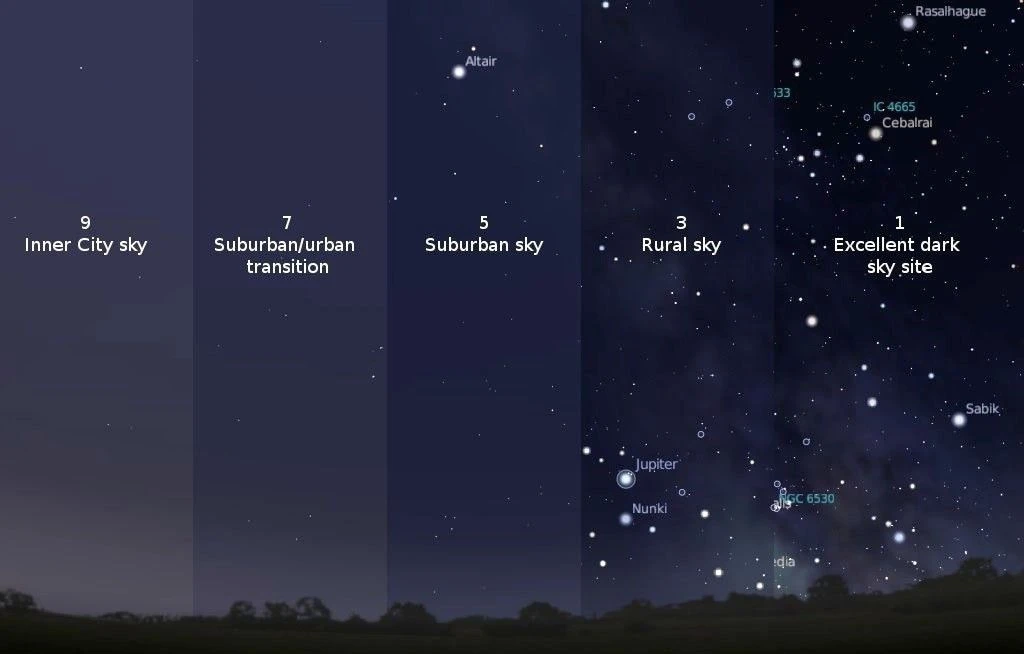
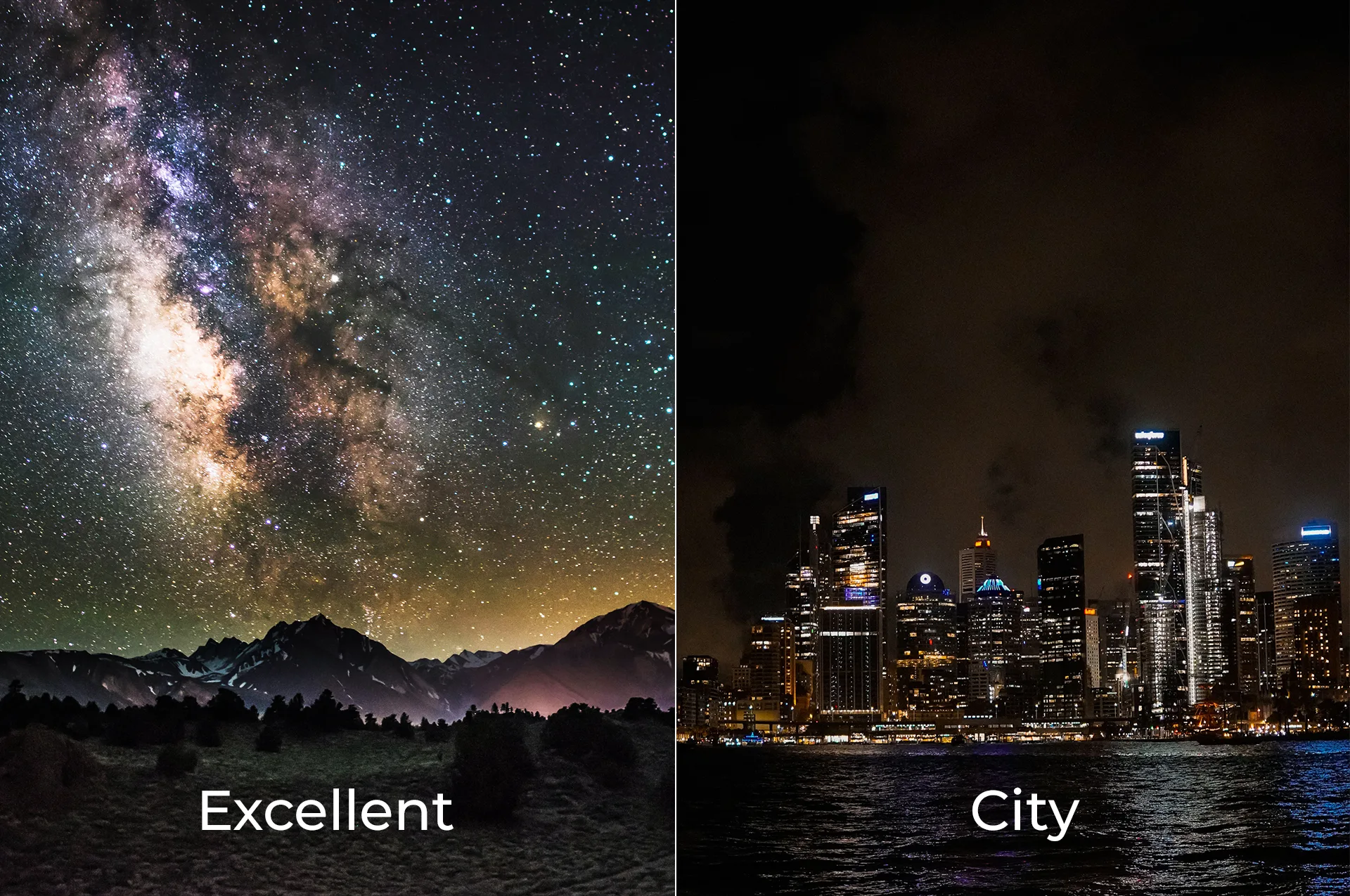
Comparison of how increasing light pollution changes the number of stars and celestial objects visible in the night sky. Credit: NASA
The darker your surroundings, the more the universe becomes visible.
City lights create light pollution, producing a glow in the atmosphere that hides faint stars and makes the Milky Way difficult or impossible to see. Under bright urban skies, you may see only the brightest stars and planets. Under genuinely dark skies, thousands of stars can become visible.
The Bortle Scale is commonly used to describe night-sky darkness. It ranges from Class 1, representing exceptionally dark skies, to Class 9, representing heavily light-polluted urban skies. NASA notes that a Bortle Class 3 or 4 location can already provide an excellent night of stargazing.
If you want to experience truly dark skies, explore our guide to 10 Places on Earth with the clearest night skies.
Getting farther away from large cities is often the simplest way to improve what you can see. Mountains, wilderness areas, remote coastlines, and dark-sky parks can all offer significantly better conditions than brightly illuminated urban areas.
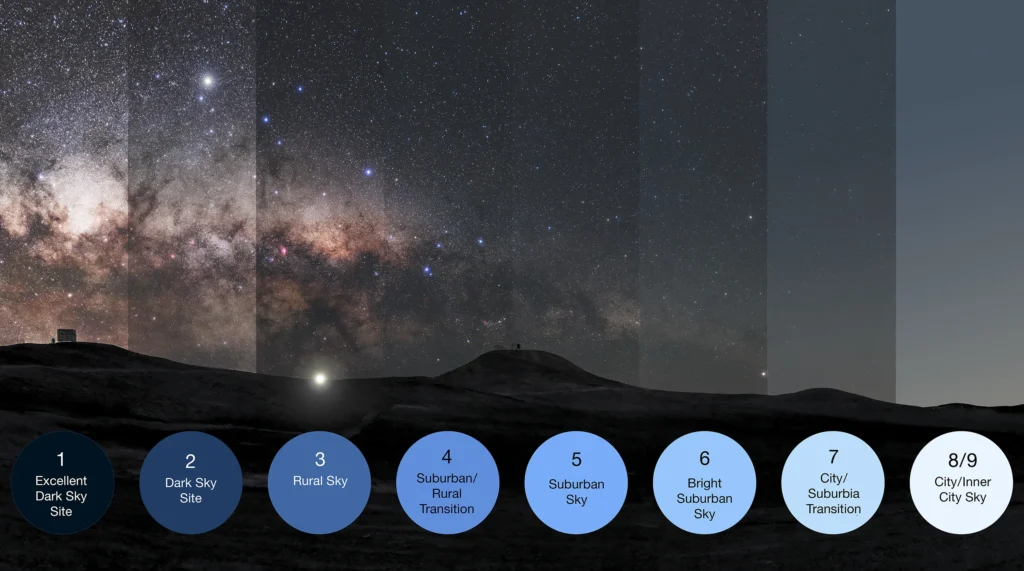
A visual comparison of the Bortle Scale, showing how increasing light pollution gradually washes out the Milky Way and reduces the number of stars visible in the night sky. Credit: ESO/P. Horálek, M. Wallner
So, When Is the Best Time to Stargaze?
Ultimately, the best time to stargaze is when several conditions come together: clear weather, a dark sky, little moonlight, and minimal light pollution.
For faint stars, meteor showers, and the Milky Way, choose a night close to the new Moon and wait until the sky is fully dark. Find a safe location away from bright lights and give your eyes roughly half an hour to adjust.
You do not need expensive equipment. Many of the most memorable views of the night sky require nothing more than your eyes, patience, and the right conditions.
And sometimes, looking into a truly dark sky does more than reveal more stars. It can change the scale at which we see our own lives — something we explore further in our article about Cosmic perspective and why space makes everyday problems feel smaller.
On the right night, the universe can become visible in ways that are easy to miss during everyday life.
Look Up. Observe Vastness.
LUOV