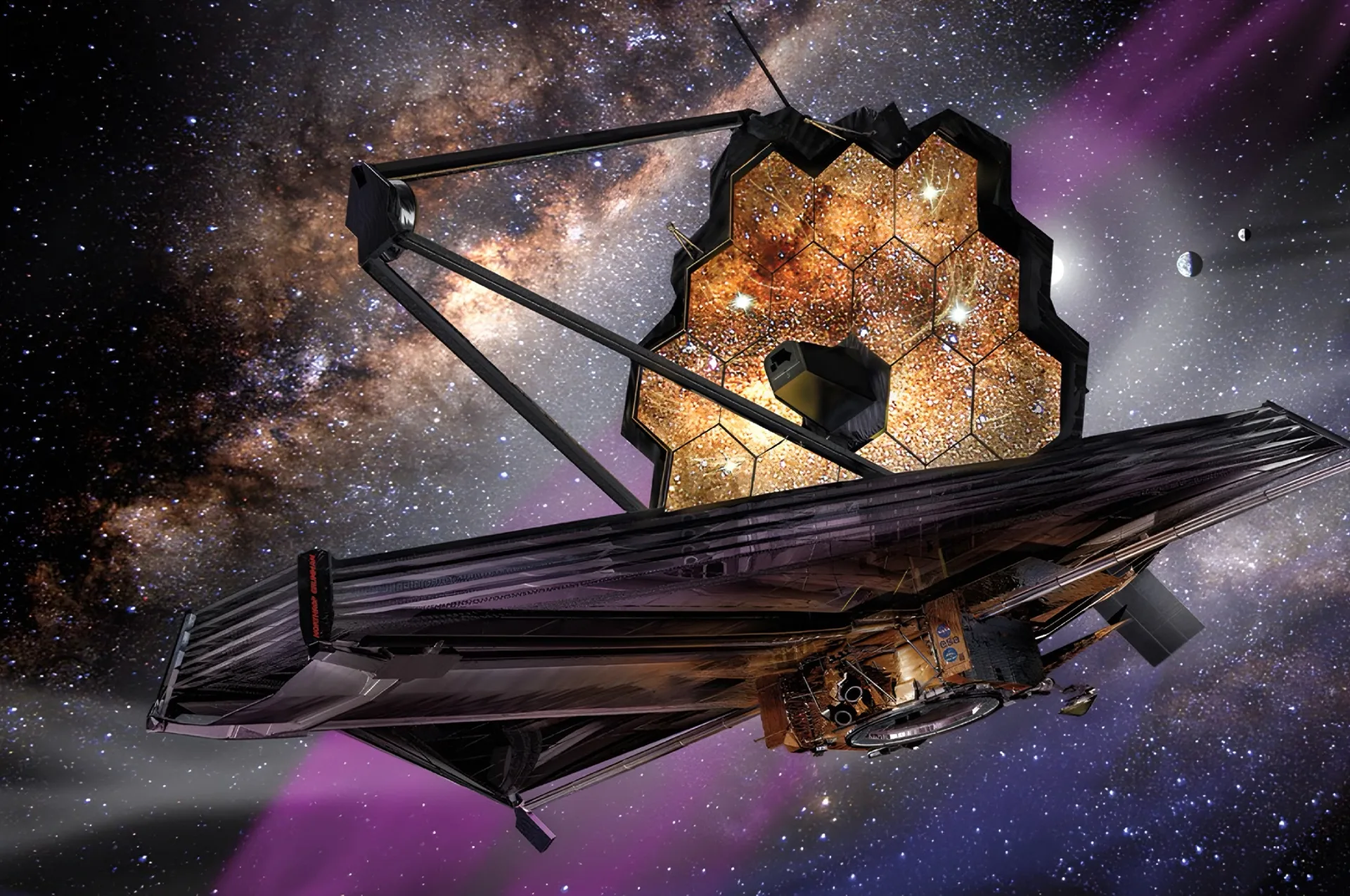
Mysterious objects in space continue to challenge what astronomers know about the universe. Despite powerful telescopes like Hubble and the James Webb Space Telescope, scientists still encounter strange worlds, unusual signals, and bizarre cosmic structures that defy easy explanation. Some of these objects have sparked decades of debate, while others remain completely unexplained.
From mysterious visitors that entered our Solar System to galaxies with impossible shapes, these cosmic wonders remind us that the universe is still full of secrets.
Here are seven of the most mysterious objects and cosmic mysteries scientists are still trying to understand.
1. Planet Nine
Credits: NASA
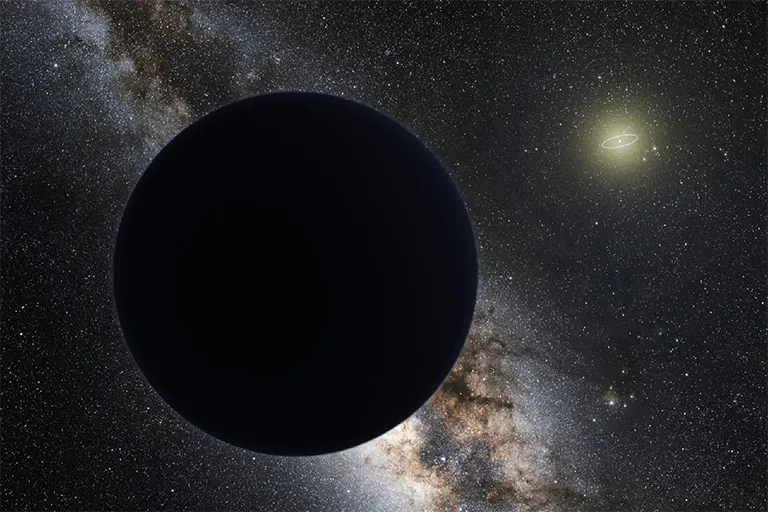
For decades, astronomers have suspected that a massive, undiscovered planet may be hiding far beyond Neptune. Known as Planet Nine, this hypothetical world has never been directly observed, yet several pieces of indirect evidence suggest it could exist in the outer reaches of our Solar System.
The strongest evidence comes from the unusual orbits of several distant icy objects in the Kuiper Belt. Instead of moving randomly, these objects appear to follow a similar pattern, as if they are being pulled by the gravity of a large unseen planet. Computer simulations show that a planet about five to ten times the mass of Earth could explain these strange orbital paths.
If Planet Nine is real, it may orbit the Sun at an enormous distance, taking 10,000 to 20,000 years to complete a single orbit. Because it would be extremely faint and far away, finding it is incredibly difficult.
Until astronomers detect it directly, Planet Nine will remain one of the greatest unsolved mysteries in modern astronomy.
2. ʻOumuamua
Credits: NASA
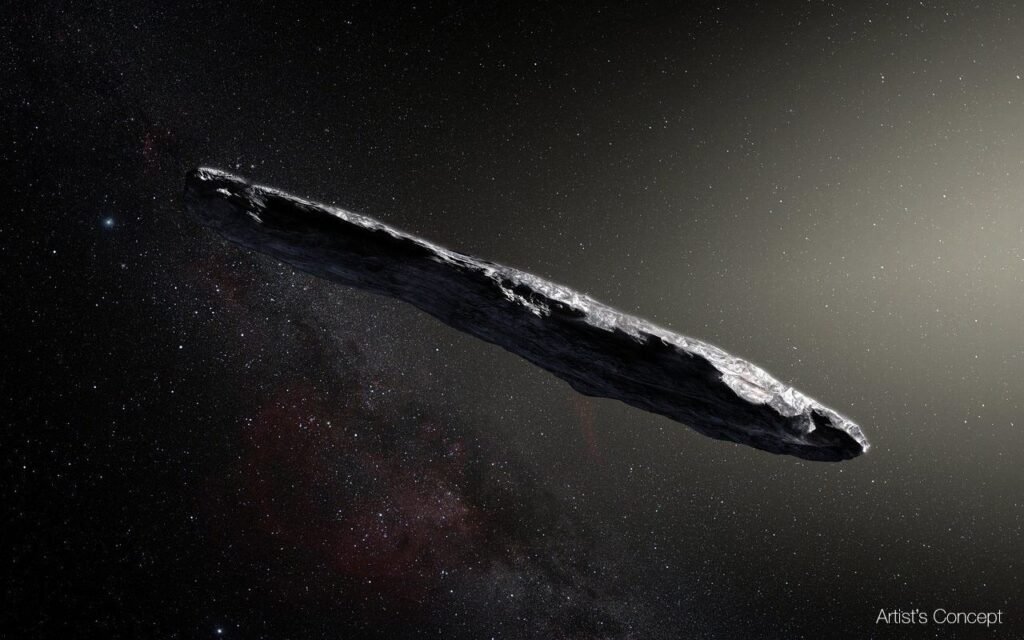
In October 2017, astronomers discovered ʻOumuamua, the first known interstellar object ever observed passing through our Solar System. It entered from outside our planetary neighborhood and was traveling so fast that it was clear it was not bound to the Sun’s gravity. Unlike ordinary asteroids or comets, ʻOumuamua had an unusual elongated, cigar shaped or possibly pancake shaped form and accelerated slightly as it moved away from the Sun without producing the visible gas tail expected from a typical comet.
Its strange behavior quickly made headlines around the world. Some researchers even suggested that it could be alien technology, such as a light sail built by an advanced civilization. However, no evidence has ever supported this idea, and most astronomers consider it highly unlikely. The leading explanation is that ʻOumuamua was a natural object made of unusual icy materials that released invisible gases, giving it a small extra push without creating a noticeable tail.
3. Hoag’s Object
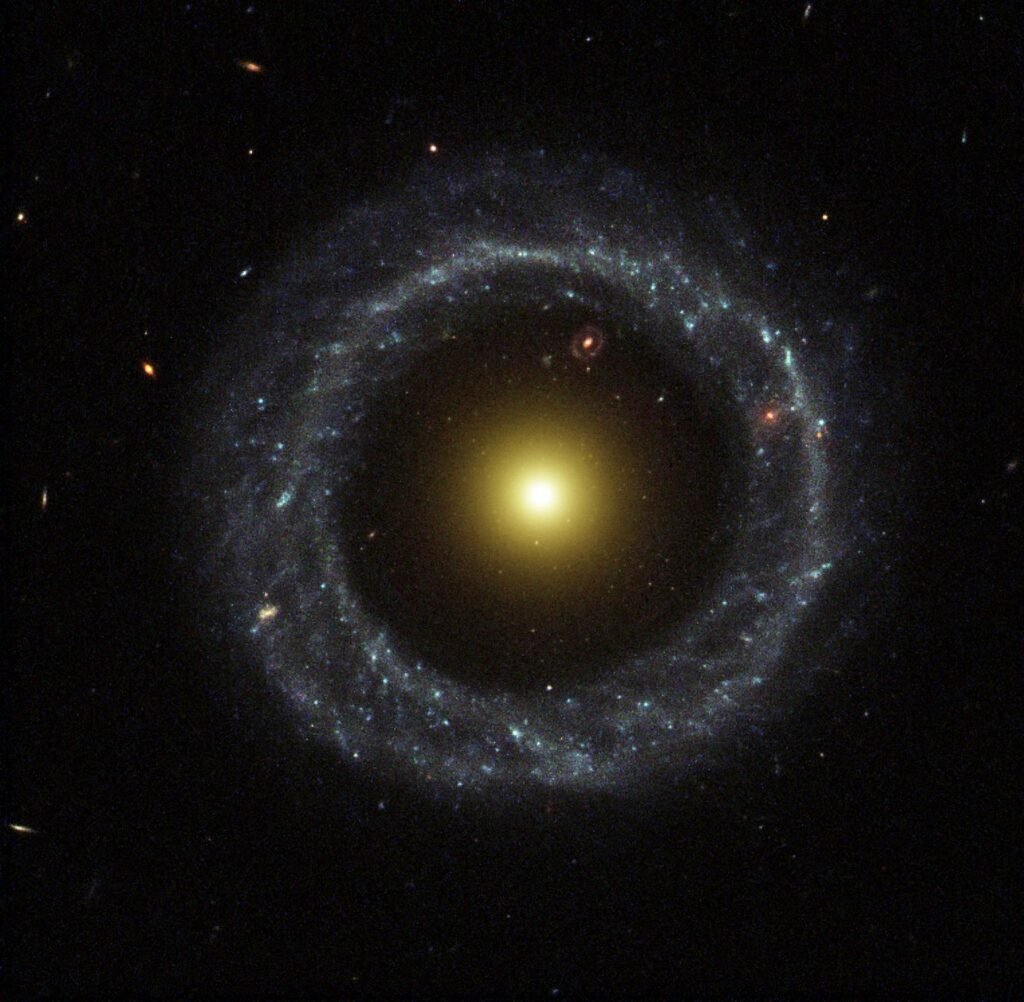
Credits: NASA
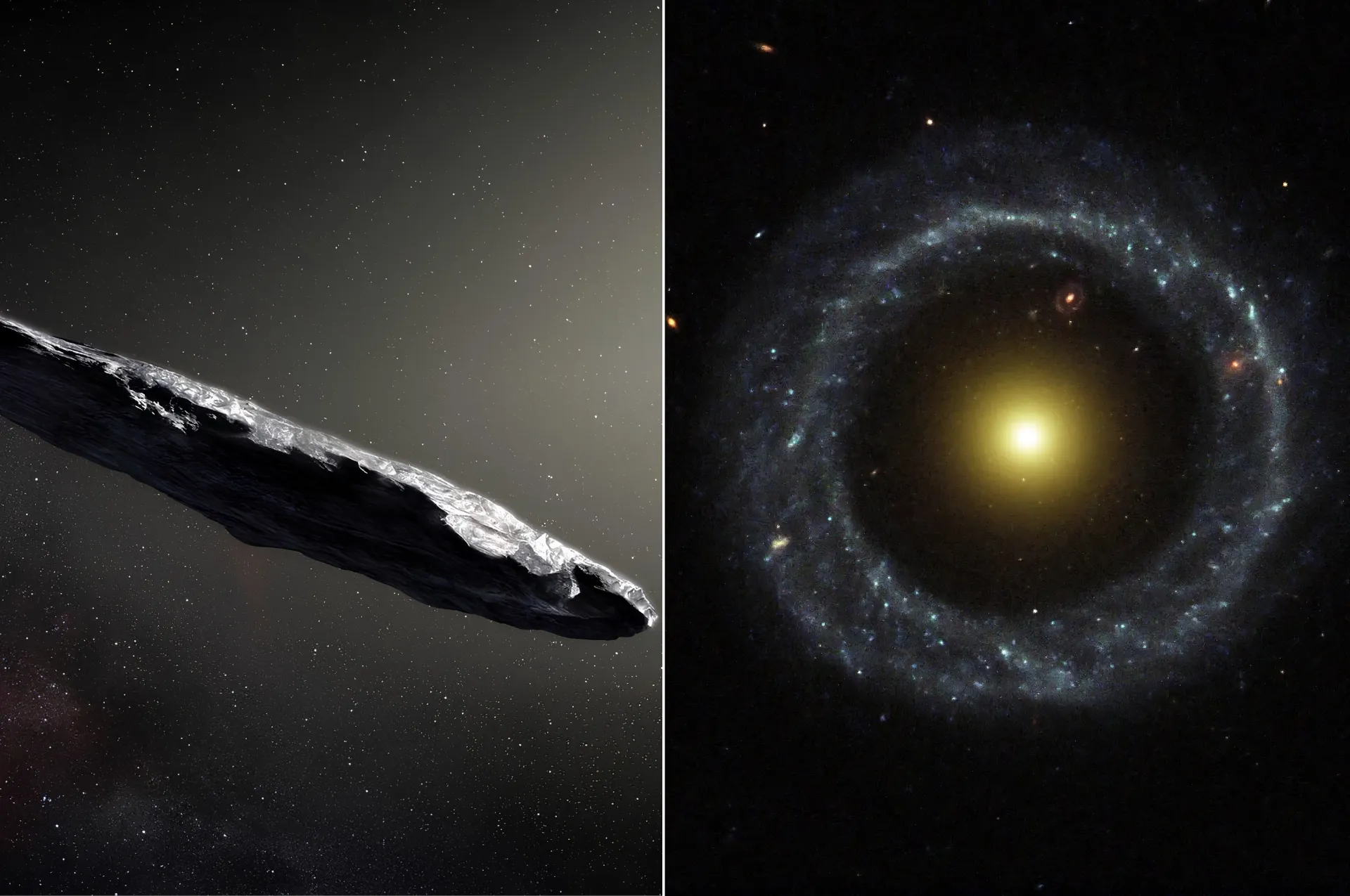
At first glance, Hoag’s Object looks so perfectly shaped that it almost appears to be artificial. This rare galaxy consists of a bright yellow central core surrounded by a nearly perfect blue ring of young stars, with a large, seemingly empty gap between the two. Its unusual symmetry makes it one of the most beautiful and mysterious galaxies ever discovered.
Astronomers have suggested several explanations for its strange appearance. One theory is that it formed after a collision with another galaxy, while another proposes that it developed naturally through unique gravitational processes. However, none of these ideas fully explain why the ring is so perfectly circular or why such a wide gap separates it from the center.
Adding to the mystery, another distant ring galaxy can be seen through the empty center of Hoag’s Object, creating an astonishing cosmic alignment. Even after decades of research, scientists still cannot fully explain how this remarkable galaxy formed, making it one of the universe’s greatest astronomical mysteries.
4. Tabby’s Star
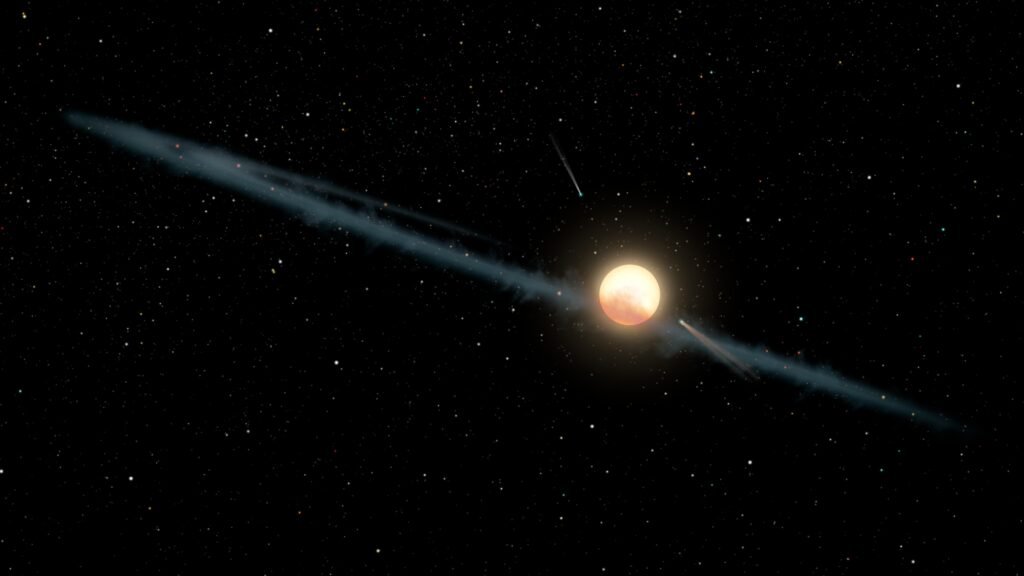
Credits: NASA
Also known as KIC 8462852, Tabby’s Star became famous after astronomers noticed that its brightness dropped by irregular amounts, sometimes by more than 20%. Unlike most variable stars, which brighten and dim in predictable cycles, Tabby’s Star showed no clear pattern, making its behavior highly unusual and difficult to explain.
The mysterious dimming sparked many theories, including the idea that an advanced alien civilization might have built massive structures around the star to capture its energy. Although this idea attracted widespread attention, scientists found no evidence to support it. Today, the leading explanation is that large clouds of dust, possibly from shattered comets or fragments of a disrupted planet, occasionally pass in front of the star and block some of its light.
5. The Red Rectangle Nebula
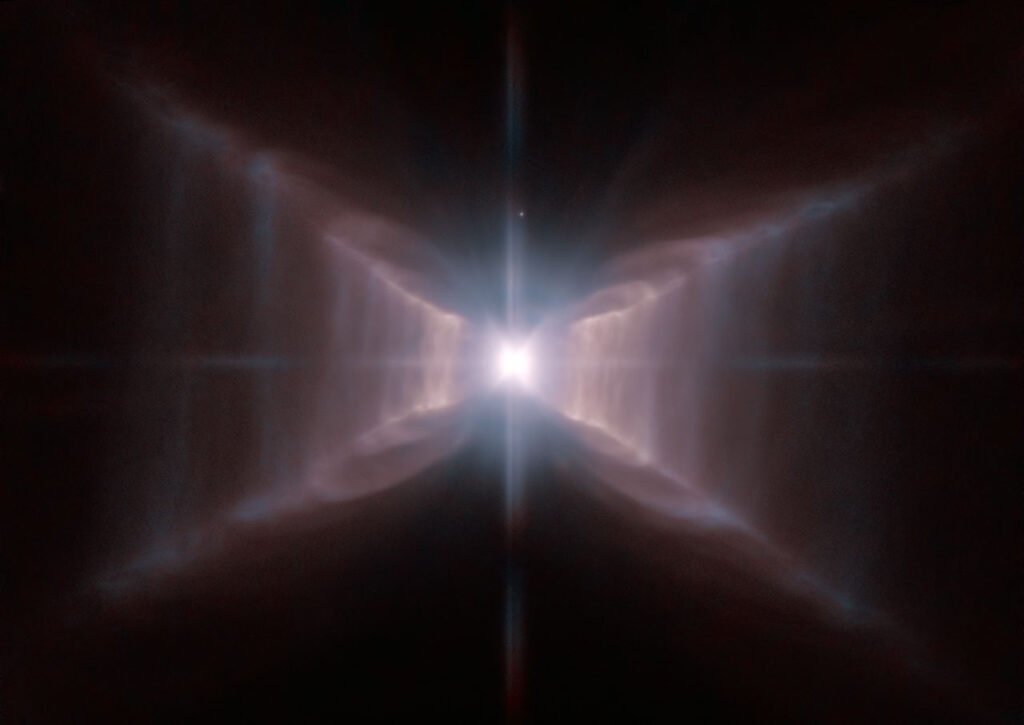
Credits: NASA / ESA
Most nebulae have irregular, round, or cloud-like shapes, but the Red Rectangle Nebula is unlike anything else in the universe. It appears as an almost perfectly glowing rectangle with a bright X shaped pattern running through its center, giving it a remarkably geometric appearance that seems almost too precise to be natural.
This unusual nebula surrounds a dying binary star system that is releasing large amounts of gas and dust into space. Scientists believe the stars and the thick disk of dust around them help shape the glowing clouds, while light escaping through narrow openings creates the nebula’s distinctive X shaped pattern.
Although astronomers understand some of the physical processes behind its formation, they still cannot fully explain why the Red Rectangle Nebula has such an incredibly symmetrical shape. Its rare appearance and unusual structure make it one of the most fascinating and mysterious objects ever discovered in space.
The Mysterious Objects in Space described above remind us that the universe is still full of unanswered questions. Every unusual discovery challenges scientists to rethink existing theories and deepen our understanding of how the cosmos works. Whether it is a strange interstellar visitor, an invisible planet, or a galaxy with an impossible shape, each mystery reveals just how much we have yet to learn.
As powerful observatories such as the James Webb Space Telescope continue exploring deeper into the universe, astronomers expect to solve many of today’s puzzles while uncovering entirely new ones. These remarkable discoveries not only expand our scientific knowledge but also inspire curiosity about the vast and mysterious universe we call home.
Look Up. Observe Vastness.
LUOV