Credit : NASA, ESA, CSA, Ralf Crawford (STScI)
Have you ever wondered what would happen if you fall into a black hole? It is one of the most fascinating questions in astronomy.
Black holes are among the strangest objects in the universe, with gravity so powerful that nothing, not even light, can escape once it gets too close. While falling into a black hole is purely hypothetical for humans, scientists have used physics and mathematics to predict what the experience might be like.
What Is a Black Hole?
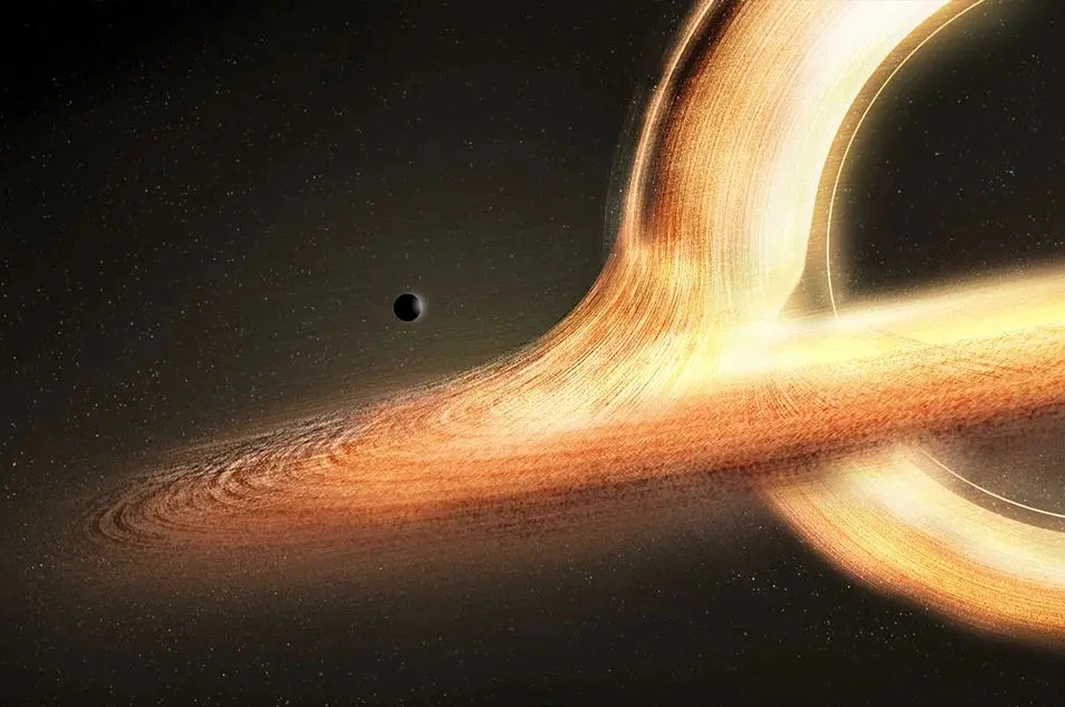
A black hole forms when a massive star collapses under its own gravity at the end of its life. This collapse squeezes a large amount of matter into an incredibly small region of space. The result is an object with gravity so strong that it creates a boundary called the event horizon.
The event horizon is often described as the “point of no return.” Once anything crosses this invisible boundary, escaping becomes impossible. From the outside, a black hole appears dark because no light can leave it. Yet its immense gravity can strongly affect nearby stars, gas, and even the shape of space itself.
What Happens as You Approach a Black Hole?
Credit: ESO/M. Kornmesser
If you were to fall into a black hole, the first thing you might notice is that your surroundings begin to look strange. The black hole’s gravity bends light, causing stars behind it to appear distorted. This effect, known as gravitational lensing, can create dramatic visual distortions in space.
Time would also behave differently. According to Einstein’s theory of relativity, strong gravity slows the passage of time. To a distant observer, your clock would appear to tick more slowly as you approach the event horizon. In fact, they might never actually see you cross it. Instead, you would seem to freeze near the edge and gradually fade from view.
However, from your own perspective, time would feel normal. You could continue moving toward the black hole without noticing anything unusual about your personal sense of time.
Spaghettification and the “Point of No Return”

Credits: Wikimedia Commons
One of the most famous predictions about what happens when you fall into a black hole is something scientists call spaghettification. Despite the funny name, it would be a deadly process.
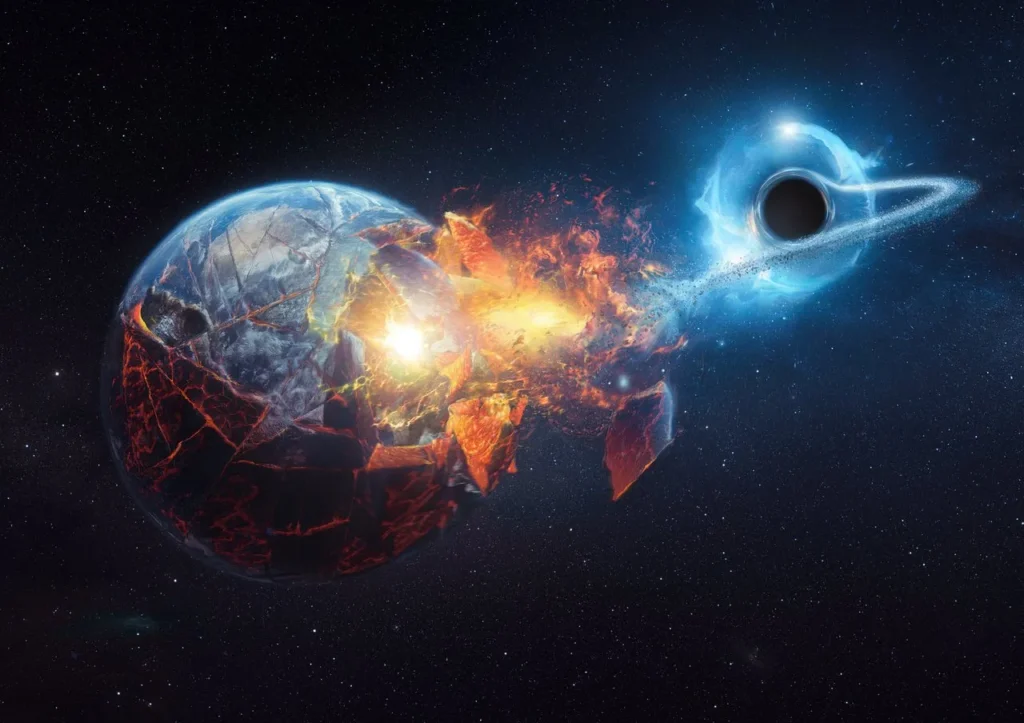
Gravity becomes stronger the closer you get to a black hole. If your feet are nearer to the black hole than your head, they would experience a stronger gravitational pull. This difference is known as a tidal force.
As these forces increase, your body would begin to stretch lengthwise while being squeezed sideways. Eventually, the stretching would become so extreme that no material could remain intact. In smaller black holes, this process would likely happen before you even reached the event horizon.
Interestingly, supermassive black holes may be different. Because they are much larger, the tidal forces at the event horizon can be weaker. In theory, you might cross the event horizon of a supermassive black hole without immediately noticing anything unusual.
Once you cross the event horizon, there is no known way back. Every possible path through space and time leads deeper into the black hole.
Scientists believe you would continue falling toward the center, known as the singularity. This is the point where matter is thought to be compressed to an extreme density. However, our current understanding of physics breaks down under these conditions.
This means that nobody knows exactly what happens at the singularity. General relativity predicts one outcome, while quantum mechanics suggests there may be more to the story. Solving this mystery remains one of the biggest challenges in modern physics.
Can Anyone Survive Falling Into a Black Hole?
Credit: NASA/ESA and G. Bacon (STScI)
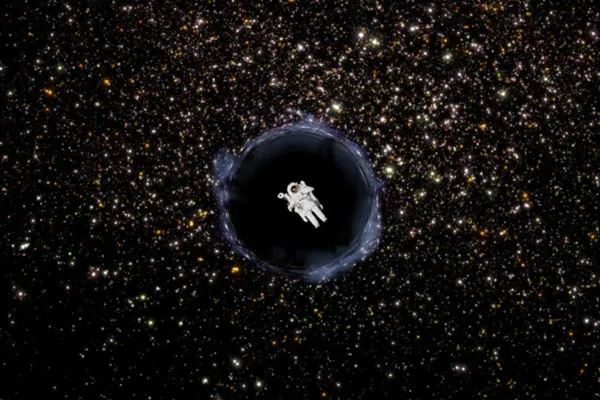
Based on current scientific knowledge, survival is extremely unlikely. Whether through intense radiation, tidal forces, or the conditions deep inside the black hole, the environment would eventually become fatal.
Even so, studying what happens when objects fall into a black hole helps scientists explore some of the deepest questions about gravity, space, time, and the nature of the universe itself. Black holes are not just cosmic traps. They are natural laboratories that may one day reveal new laws of physics.