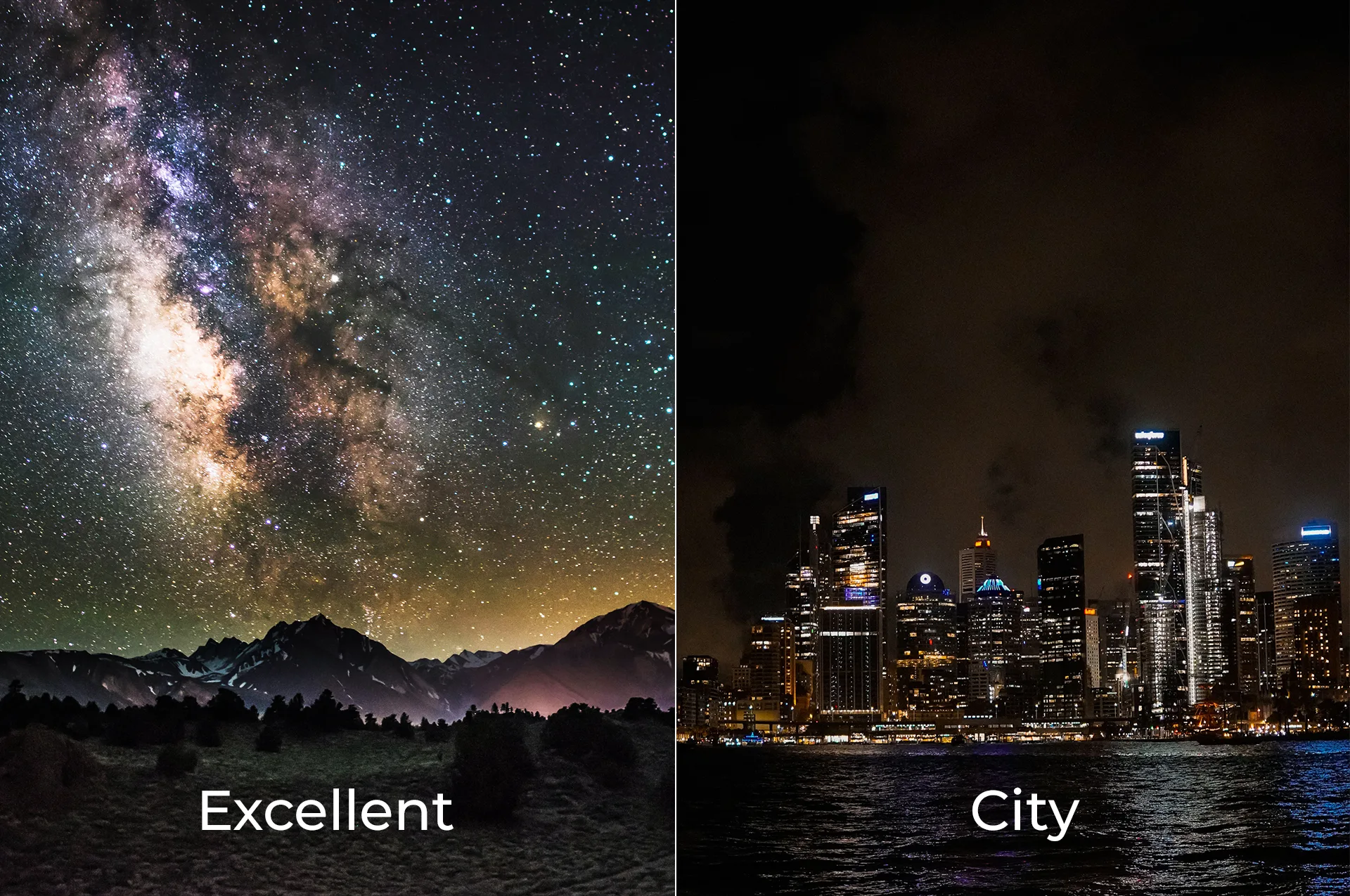
The night sky without light pollution can look completely different from what most people see in towns and cities. Instead of only a few bright stars scattered across the darkness, the sky can appear filled with thousands of stars, faint star clouds and the glowing band of the Milky Way.
Light pollution occurs when artificial light from streets, buildings, advertising and other sources changes the natural brightness of the nighttime environment. One of its effects is skyglow, the brightening of the night sky above inhabited areas. DarkSky International’s guide to light pollution
In a truly dark location, much more of the universe becomes visible to the naked eye.
What You Can See in a Night Sky Without Light Pollution
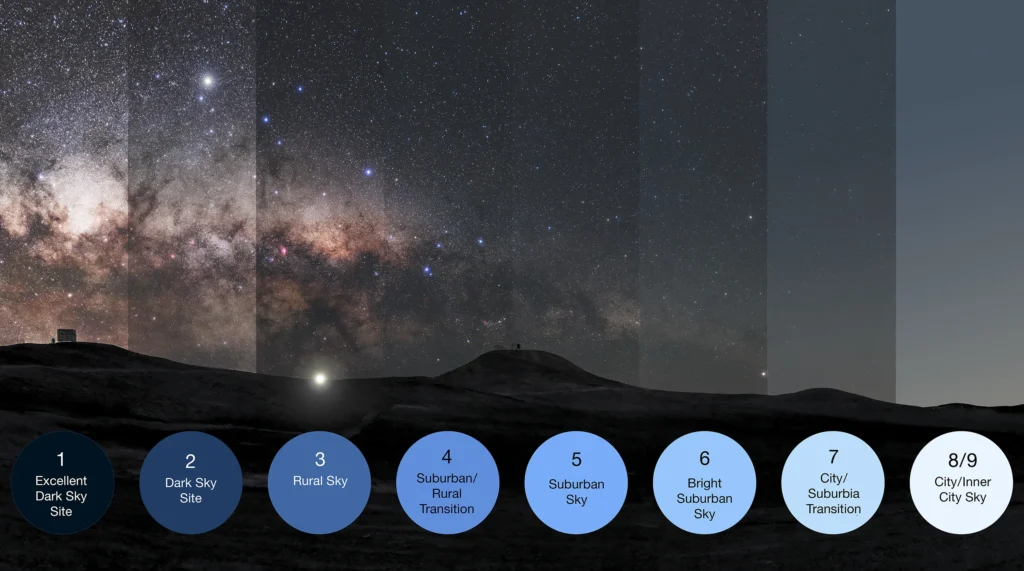
A visual comparison of the Bortle Scale, showing how increasing light pollution gradually washes out the Milky Way and reduces the number of stars visible in the night sky. Credit: ESO/P. Horálek, M. Wallner
Under a very dark sky, one of the first things you may notice is simply more stars. Many stars that disappear in cities become visible again, making familiar constellations look brighter, richer and much more crowded.
The Milky Way can become one of the most striking features overhead. Instead of appearing as a faint streak, it may look like a broad, cloudy band stretching across the sky, revealing the combined glow of enormous numbers of distant stars.
On a clear, moonless night, you may also notice dark patches within the Milky Way. These are regions where clouds of interstellar dust block the light from stars behind them, creating dark lanes through the brighter parts of our galaxy.
Some star clusters and other faint celestial objects also become easier to notice. Even the Andromeda Galaxy, around 2.5 million light-years away, can be visible to the unaided eye under good conditions. NASA describes it as easily visible from a dark-sky site. NASA’s guide to the Andromeda Galaxy
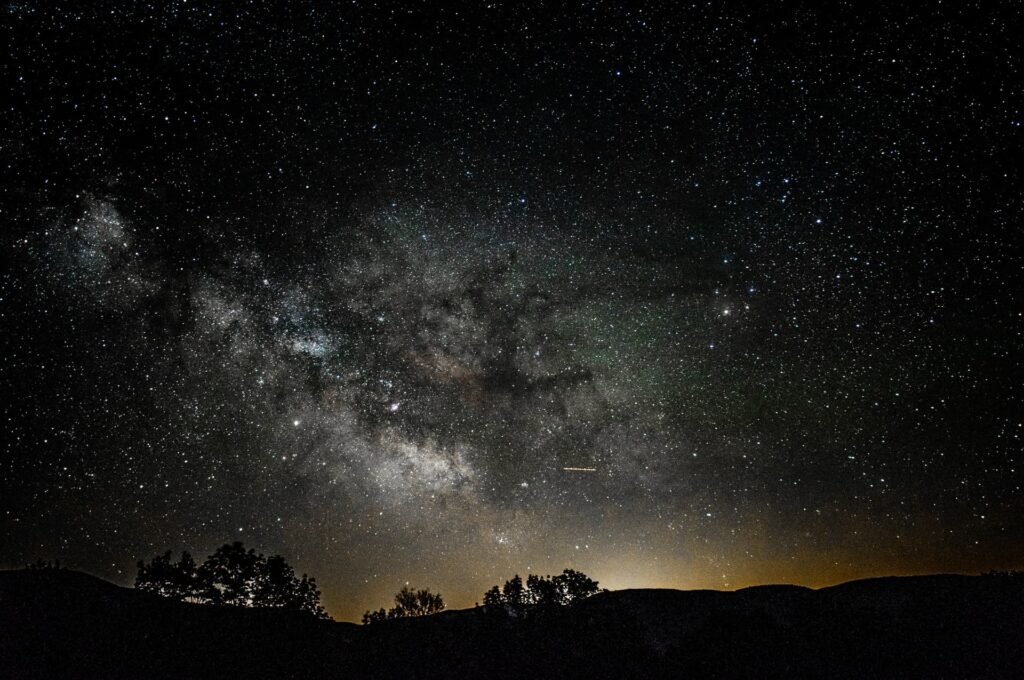
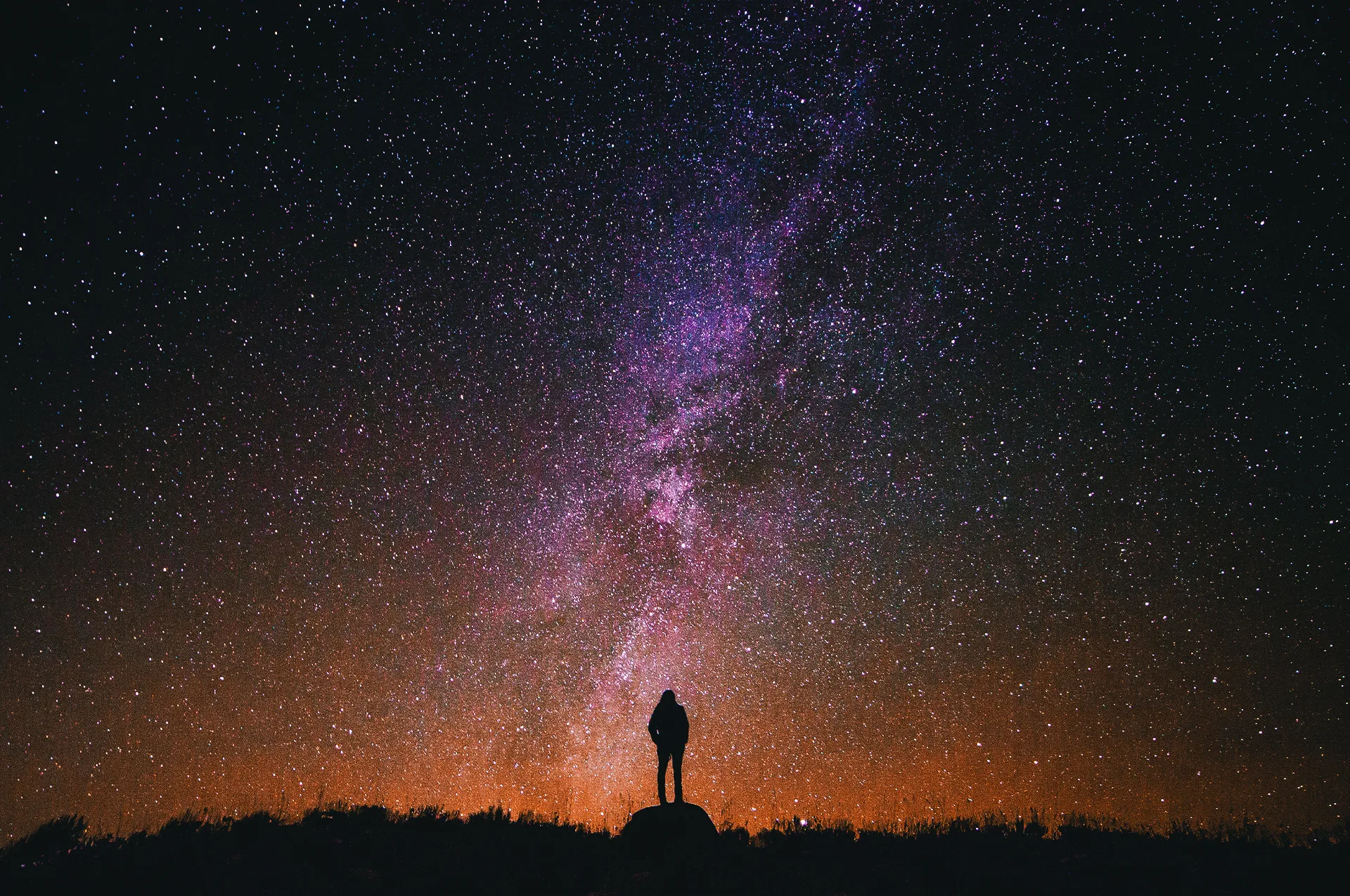
The Milky Way appears clearly above a dark landscape under a sky largely free from light pollution. Credit: Pexels / Skyler Ewing.
You may also notice that even a natural night sky is not perfectly black.
Very faint atmospheric light known as airglow can sometimes create subtle green, red or yellow tones in extremely dark skies. Airglow is produced by processes involving atoms and molecules high in Earth’s atmosphere and is much easier to detect away from artificial light. NASA’s explanation of airglow
Dark Skies Reveal More Deep-Sky Objects
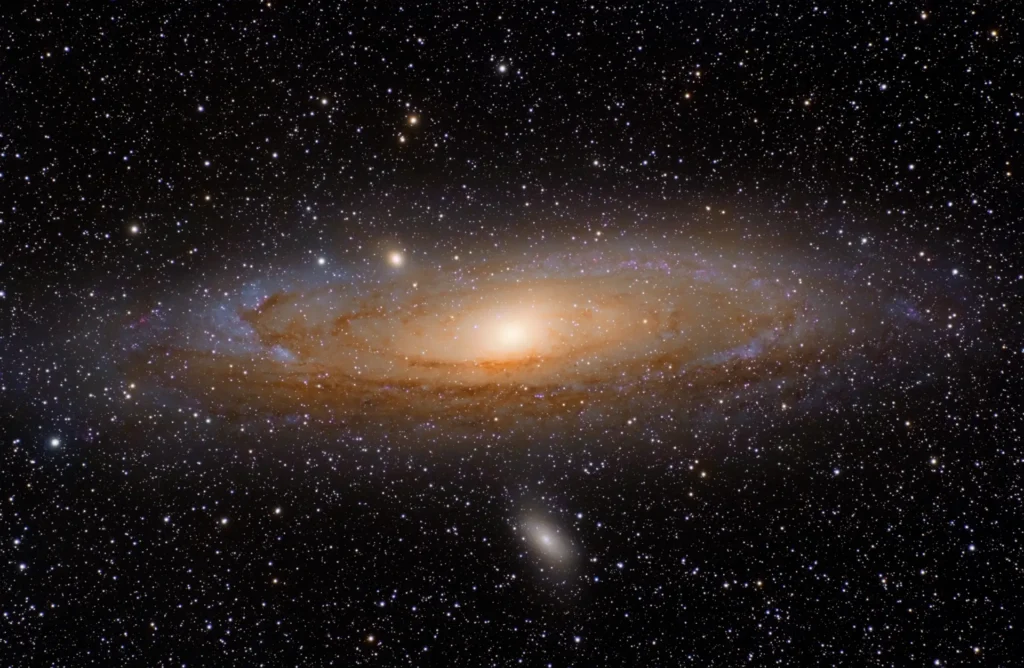
The Andromeda Galaxy appears as a bright spiral galaxy surrounded by countless stars, showing its glowing core and extended dusty structure. Credit: Brody Wesner
A dark sky does more than reveal additional stars. It can also make objects far beyond our Solar System easier to observe.
The Andromeda Galaxy may appear as a faint fuzzy patch, while some bright star clusters can become visible with the naked eye. Nebulae and other deep-sky objects are often much more difficult to see without binoculars or a telescope, but darker skies dramatically improve their contrast.
This is why observing conditions matter so much. Even a small amount of artificial skyglow can hide faint celestial objects that become noticeable once you travel away from a city.
The Moon can make a similar difference. A bright Moon naturally increases the brightness of the night sky, so moonless nights are usually better when your goal is to see the Milky Way and other faint objects.
For more on choosing the right conditions, read our guide to the Best time to stargaze.
Best Places to See the Night Sky Without Light Pollution
The night sky without light pollution is easiest to experience in remote areas far from large cities.
Some places around the world are particularly famous for their dark skies. Aoraki Mackenzie International Dark Sky Reserve in New Zealand combines protected night skies with a long history of astronomical observation. The reserve covers Aoraki / Mount Cook National Park and the Mackenzie Basin and has had outdoor lighting controls in place since the 1980s.
Natural Bridges National Monument in Utah is another remarkable example. It became the world’s first International Dark Sky Park in 2007, and the National Park Service notes that thousands of stars can be visible during a night in some exceptionally dark locations.
Other famous observing regions include the Atacama Desert in Chile, NamibRand Nature Reserve in Namibia, La Palma in Spain’s Canary Islands, Hanle in Ladakh, India, and remote parts of the Australian Outback.
These places show just how dramatically the sky changes when artificial light is kept to a minimum. The Milky Way becomes more structured, constellations become crowded with additional stars and objects that disappear over cities begin to emerge.
Seeing the Sky as It Really Is
Seeing the night sky without light pollution can change the way you understand our place in space. What appears almost empty from a brightly lit city can become a detailed landscape of stars, galaxies, dark dust clouds and the structure of our own Milky Way.
You do not need an expensive telescope to experience that difference. A clear night, a safe location away from artificial lights and enough time for your eyes to adapt can reveal a surprising amount of the universe.
If you are new to observing the night sky, our guide on How to Stargaze Without a Telescope: A Beginner’s Guide explains how to get started using only your eyes and a few simple techniques.
Look Up. Observe Vastness.
LUOV